The Psychology of Product Display

Before you pick any display case ideas for your shop, you need to understand how customers actually look at products in a physical store. Retail psychology research consistently shows that the way you arrange items inside a display case has a measurable impact on sales — sometimes increasing revenue by 20-30% without adding a single new product to your inventory.
Here are the six core principles that drive every successful product display:
Eye-Level Sells Best
Products placed at eye level (approximately 120-160cm from the floor) receive the most visual attention. This is why supermarkets charge premium brands higher slotting fees for eye-level shelves. In your display case, position your highest-margin items at eye level. Budget items and impulse purchases belong on the lower shelves where customers who are already engaged will naturally look next.
The Rule of Three
Odd-numbered groupings feel more natural and visually appealing than even numbers. When arranging products inside a display case, group them in threes — three sizes of the same product, three colour variations, or three complementary items. This creates visual rhythm without overwhelming the customer. A display with 2 items feels sparse; 4 items feels cluttered; 3 items feels intentional.
Colour Blocking
Group products by colour family to create visual impact from a distance. A display case with colour-blocked merchandise draws the eye far more effectively than a random mix of colours. Customers notice colour-blocked displays from 3-5 metres away, which is critical in shopping malls where you are competing for attention with dozens of surrounding shops.
Focal Points
Every display case needs one clear focal point — the hero product that anchors the entire arrangement. This is typically your best-seller, newest arrival, or highest-margin item. Supporting products should lead the eye toward the focal point, not compete with it. If everything in the case demands equal attention, nothing stands out.
Negative Space
The empty space around products is not wasted space — it communicates value. Luxury brands use generous negative space to signal premium positioning. A single watch displayed in a large clear case appears more valuable than the same watch crammed into a shelf with 20 others. If you want customers to perceive your products as high-quality, give them room to breathe inside the display case.
Price Anchoring
Place your most expensive items at eye level where customers see them first. This sets a psychological anchor — after seeing the premium-priced item, mid-range products below it appear more affordable by comparison. This technique works especially well in jewellery stores, electronics shops, and cosmetics counters where you sell across multiple price tiers.
Display Case Ideas by Store Type
Different businesses need different store display ideas. The display case that works perfectly for a bakery would be completely wrong for a jewellery store. Here are specific display case ideas tailored to six common shop types in Malaysia:
Cafe & Bakery Display Ideas
Cafes and bakeries live or die by visual appeal. Customers decide what to order based on how the food looks behind the counter — not from the menu. Your display case is your most powerful sales tool.
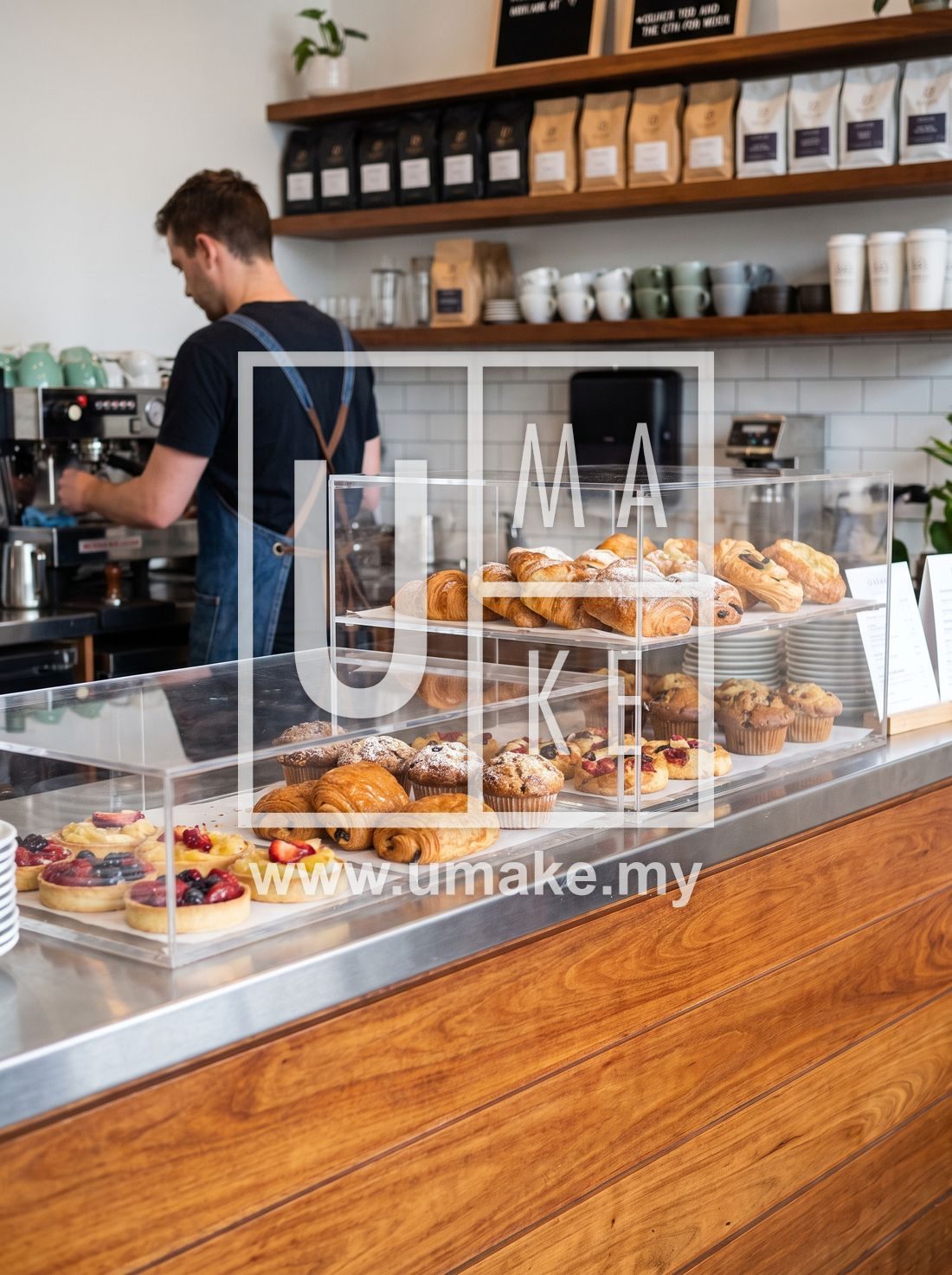
Countertop pastry cases with clear acrylic panels on all sides let customers see products from every angle. The transparency is critical — tinted or frosted glass hides the very details (golden crust, chocolate drizzle, fruit garnish) that trigger purchasing decisions. Choose cases that are at least 30cm deep to accommodate standard cake plates and tiered pastry arrangements.
Tiered cake stands inside the display case create vertical interest and maximise visible product density without overcrowding. A three-tier acrylic stand can showcase 9-12 individual pastries in the footprint of just 3-4 items placed flat. Position your premium items (whole cakes, decorated pastries) on the top tier at eye level, with grab-and-go items on the lower tiers.
Menu holder displays integrated beside or on top of the case help customers connect what they see with what they can order. An A5 acrylic stand-up menu holder next to each product category (cakes, pastries, drinks) reduces questions for staff and speeds up ordering during peak hours.
Jewellery & Accessories Display Ideas
Jewellery stores require display cases that balance security with visibility. Customers need to see fine details — gemstone clarity, metal finish, chain thickness — but products must remain protected from theft and handling damage.
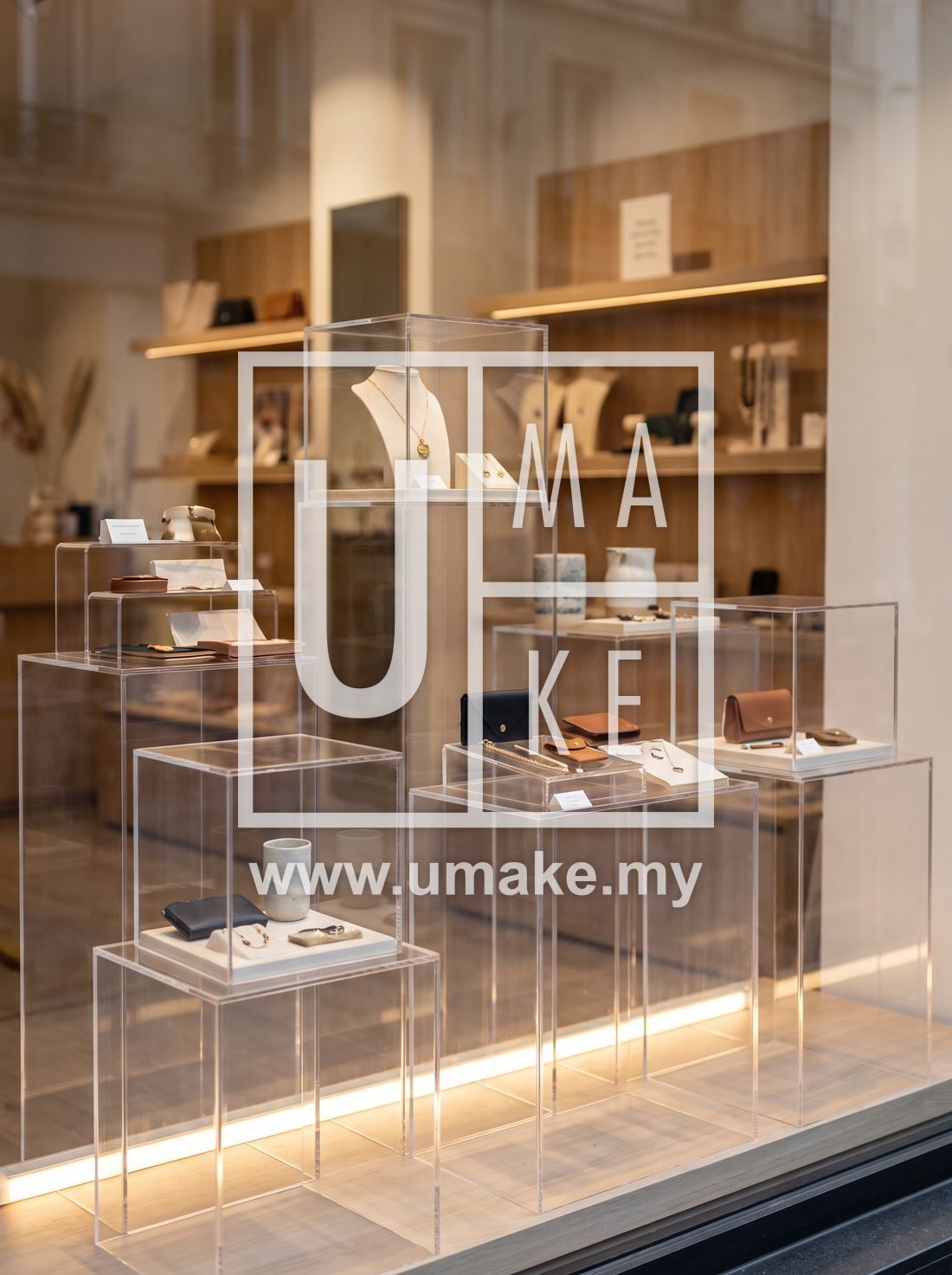
Locked countertop cases with acrylic or glass tops provide security without creating a psychological barrier. The key is keeping the case height low (8-15cm internal height for rings and earrings, 20-30cm for necklaces) so customers look down into the display rather than through a tall glass wall. Low-profile cases feel more accessible and encourage customers to ask for a closer look.
Velvet-lined interiors in dark colours (black, navy, burgundy) provide contrast that makes silver and gold pieces pop visually. The velvet also prevents scratching and keeps items from sliding when customers lean against the counter. Pair dark velvet with clear acrylic cases for maximum contrast between the display framework and the products.
LED-lit displays are non-negotiable for jewellery. Cool-white LEDs (5000-6500K) make diamonds and silver sparkle, while warm LEDs (2700-3000K) enhance gold tones. Many UMAKE acrylic cases can be customised with integrated LED strip channels — the light transmits through the acrylic edges for a subtle glow effect that highlights without harsh shadows.
Spinning displays for earring collections and ring sets let customers browse the full range without opening the case. A small motorised turntable inside a clear acrylic dome case creates movement that naturally draws the eye from across the store.
Electronics & Phone Shop Display Ideas
Electronics stores need to showcase individual products as the hero rather than displaying large quantities. Customers compare specifications, so your display case layout should facilitate side-by-side evaluation.
Individual product pedestals elevate each phone, tablet, or gadget to its own stage. Clear acrylic risers in graduated heights (5cm, 8cm, 12cm) create a staircase effect that gives every product its own visual space. This mimics the display strategy used by Apple and Samsung in their flagship stores — each device feels important and premium.
Comparison displays arrange competing products side-by-side at the same height with specification cards below each item. This layout acknowledges how electronics shoppers actually behave — they compare features, prices, and sizes directly. Arrange phones from budget (left) to premium (right), matching the natural left-to-right reading pattern in Malaysia.
Use clear acrylic display cases without backing panels. Electronics customers want to see devices from all angles — screen, back design, thickness profile. A fully transparent case lets them evaluate the product's physical design without handling it, reducing fingerprints and accidental drops.
Cosmetics & Skincare Display Ideas
Cosmetics stores deal with two competing needs: displaying a wide range of SKUs while keeping the arrangement visually clean and shoppable. The solution lies in vertical tiered displays that maximise product count without visual chaos.
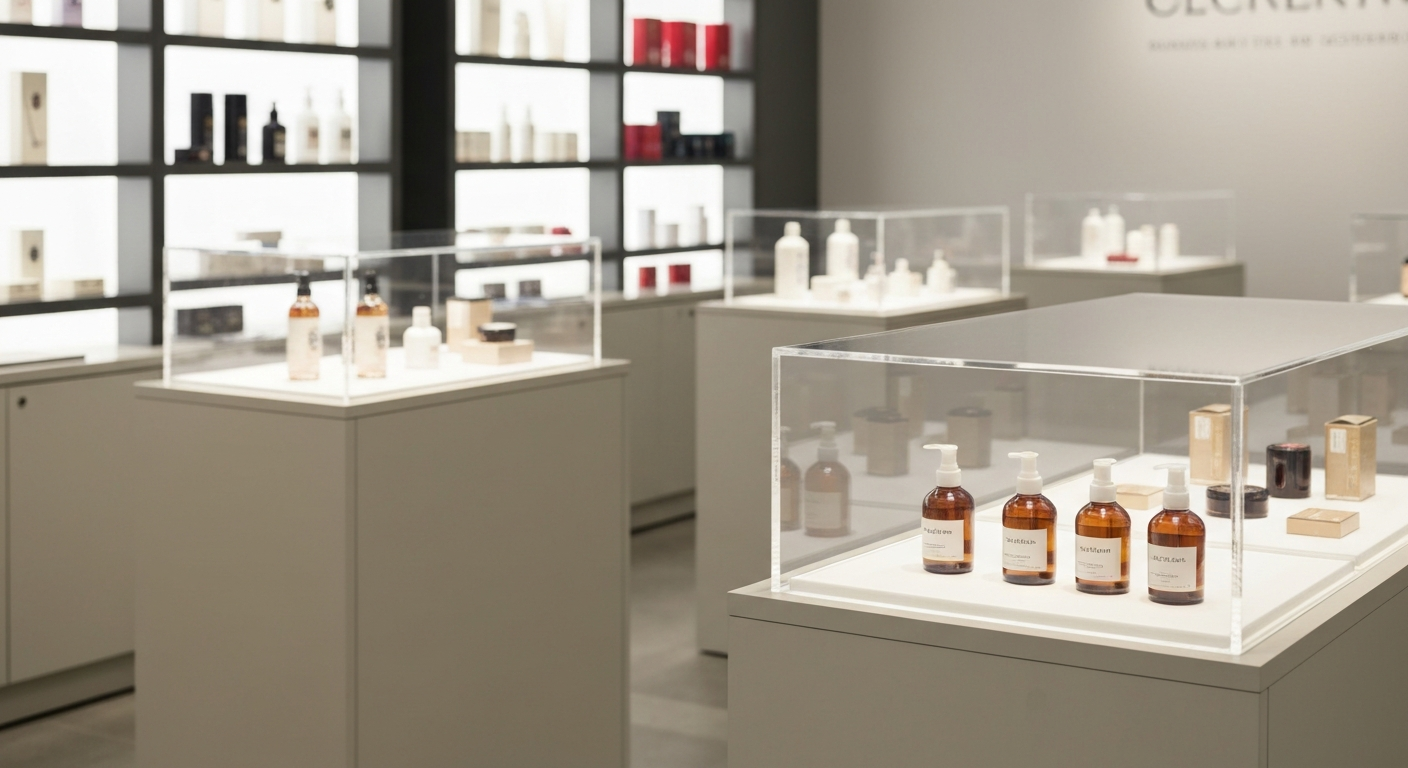
Tiered risers in 3-4 steps allow you to display 3-4 rows of products within the footprint of a single row. Each tier is angled slightly toward the customer (10-15 degrees) so labels face forward and are readable without picking up the product. Clear acrylic risers are ideal because they disappear visually, letting the colourful product packaging do the talking.
Group by product line, not by product type. Customers shopping for a specific brand want to see the full range together — cleanser, toner, serum, moisturiser. A dedicated acrylic display case per brand or product line helps customers self-serve and discover complementary products they did not plan to buy.
Need help with Acrylic?
Get a free quote from UMAKE — custom signage designed and manufactured in Malaysia.
Tester vs sealed display separation is essential for hygiene and loss prevention. Place sealed retail stock inside locked acrylic cases and position tester units on open shelves beside the case. Customers can try the tester, confirm they like the product, then request the sealed unit from inside the display. This workflow reduces product waste from opened returns by up to 60%.
Boutique & Gift Shop Display Ideas
Boutiques and gift shops thrive on visual storytelling. Unlike commodity stores where customers know exactly what they want, boutique shoppers browse for inspiration. Your display case ideas should create discovery moments that surprise and delight.
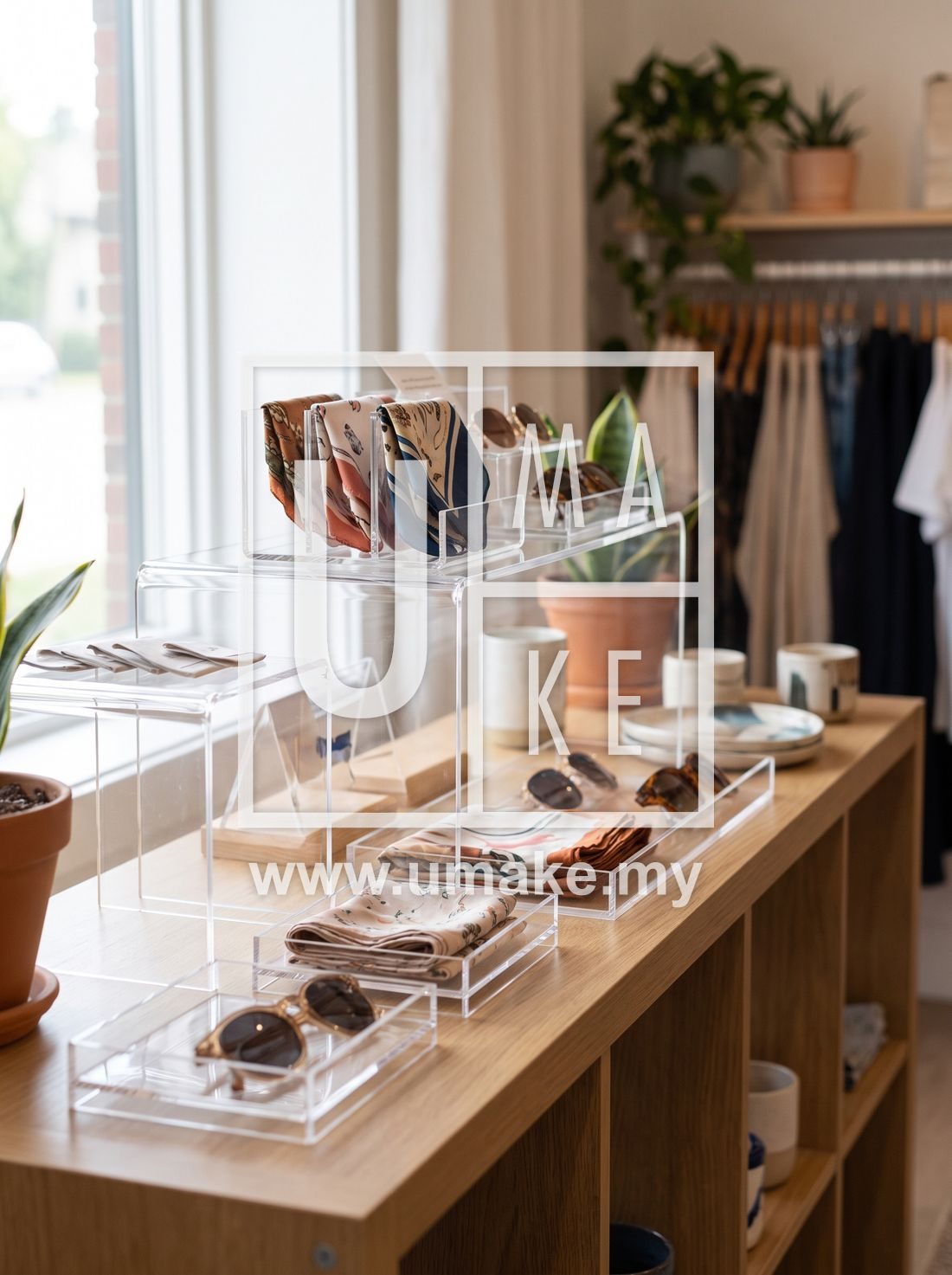
Mixed-height displays using acrylic boxes, risers, and pedestals of different sizes create visual energy that flat, uniform shelving cannot match. Alternate between tall items (vases, bottles, standing frames) and short items (candles, cards, small accessories) to create a natural rhythm the eye follows around the display.
Feature walls with wall-mounted acrylic display shelves create a gallery-like presentation for premium gift items. Floating shelves in clear acrylic are nearly invisible against a white wall, making the products appear to hover — a dramatic effect that photographs beautifully for social media as well.
Seasonal rotation tips: Refresh your display cases every 2-4 weeks using the same acrylic cases but different product arrangements. Monday visitors should see a different front-of-store display than they saw the previous week. The modular nature of acrylic display components (stackable cases, rearrangeable risers, interchangeable signage holders) makes weekly rotation practical without buying new fixtures.
Hobby & Collectibles Display Ideas
Collectible shops and hobby stores cater to passionate customers who appreciate proper product display. A Gundam model displayed in a dusty open shelf feels neglected; the same model in a clear acrylic case with proper lighting feels like a museum piece worth its price tag.
Glass-front cabinets with acrylic internal shelving combine the security of a lockable cabinet with the clarity of transparent display. Use adjustable shelf heights to accommodate different figure sizes — 15cm for small figures, 25cm for standard 1/7 scale, and 35cm for larger kits and dioramas.
Stackable display cases let you grow your display vertically as your range expands. UMAKE's self-assembly stackable display cases are specifically designed for figurine and collectible shops — dustproof, crystal-clear acrylic, modular stacking design that adds tiers without tools.
Themed groupings organise products by franchise, era, or style rather than by price or size. Group all Marvel figures together, all vintage toys together, all gaming merchandise together. Collectors shop by passion, not by budget. A themed display case tells a story that resonates with their specific interest and makes them feel understood.
5 Display Layout Principles
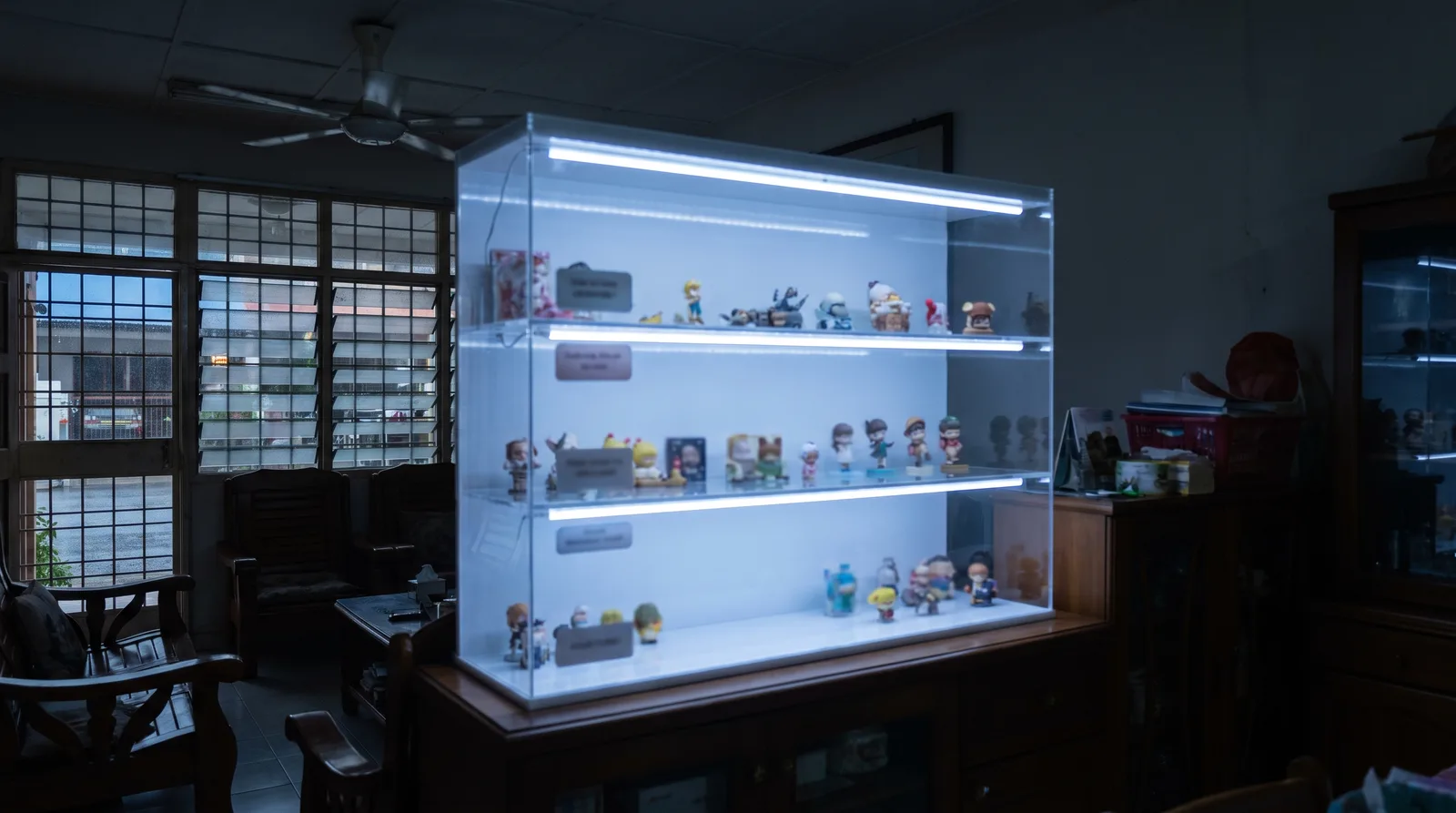
Regardless of your store type, these five visual merchandising principles apply to every display case arrangement:
1. Rule of Thirds
Divide your display case mentally into a 3x3 grid. Place your most important products at the intersections of these grid lines — these are the natural focal points where the human eye rests first. The centre is not the strongest position; the upper-left and upper-right intersections receive the most attention from Malaysian shoppers who read left-to-right.
2. Pyramid Arrangement
Build displays in a pyramid or triangle shape — tallest item in the centre or back, gradually descending in height toward the edges and front. This creates a natural visual hierarchy that guides the eye from the apex (hero product) down to supporting items. Pyramids feel stable and premium, which is why luxury stores use this arrangement almost exclusively.
3. Colour Harmony
Choose products that share a colour palette when arranging a single display case. Complementary colours (purple and gold, blue and orange) create vibrant energy for youth-oriented stores. Analogous colours (different shades of blue, or cream to brown gradient) create calm sophistication for premium brands. Avoid putting clashing colours together — a neon green product next to a pastel pink product creates visual noise.
4. Lighting Placement
Light should come from above and slightly in front of the display, mimicking natural sunlight. Top-mounted LED strips inside acrylic cases eliminate shadows under shelves. Avoid backlighting for opaque products (it creates silhouettes instead of detail). Side-lighting works well for transparent or translucent items like glassware and crystal — it catches edges and creates sparkle effects.
5. Rotation Schedule
No display should remain unchanged for more than 4 weeks. Even your best-selling arrangement will eventually become invisible to regular customers — they literally stop seeing it. Set a calendar reminder to rotate displays every 2-3 weeks. You do not need to buy new products; simply rearrange existing items, swap products between cases, or change the grouping logic (by colour one month, by use case the next).
Why Acrylic Display Cases Work Best
Among all display case materials — glass, wood, metal, MDF — acrylic display cases consistently outperform for retail environments. Here is why shop owners across Malaysia are switching to acrylic:
Transparent — Does Not Compete with Products
Acrylic is crystal-clear with 92% light transmittance (higher than glass at 90%). This means the display case itself virtually disappears, letting your products be the star. Wooden display units and coloured metal frames draw attention to themselves; clear acrylic draws attention to what is inside. For visual merchandising, the best display fixture is one that customers do not notice — they notice the products.
Customizable — Fits Any Layout
Acrylic can be laser-cut and assembled into any size, shape, or configuration. Need a display case that is exactly 42cm wide to fit between two existing shelves? Need an L-shaped counter display that wraps around a column? Need integrated slots for price tags or product labels? Acrylic can be customised to your exact store layout without the cost of custom carpentry. At UMAKE, we manufacture custom display cases to your specifications — just WhatsApp us your measurements.
Lightweight — Easy to Rearrange
Acrylic weighs approximately half as much as glass of the same thickness. A countertop display case in 3mm acrylic can be picked up and moved by one person in seconds. This is critical for seasonal merchandising rotations — if your display cases are too heavy to move easily, you will never actually rotate them. Lightweight fixtures encourage experimentation with different arrangements.
Brandable — Logo Printing Available
Acrylic can be printed, engraved, or frosted with your brand logo, store name, or product category labels. A frosted logo on the base of a clear display case adds brand presence without obscuring the products. Engraved text on the front edge serves as both decoration and wayfinding. You cannot achieve this level of brand integration with off-the-shelf glass cases.
Affordable — Change Displays Without Guilt
Custom acrylic display cases cost a fraction of glass or wood alternatives. This means you can afford to have different display configurations for different seasons, promotions, or product launches — without treating each display case as a decade-long investment. When a display concept does not work, retire it and try something new. The low cost removes the fear of experimentation that holds back many kedai owners from improving their display ideas.
Common Display Mistakes to Avoid
Even the best display case ideas fail when these six common mistakes creep in. Check your store against this list:
Overcrowding
The number one mistake in Malaysian retail. Shop owners feel that empty space inside a display case is wasted money — so they cram in as many products as possible. The result is a cluttered mess where no single product stands out and customers cannot focus on anything. Reduce your displayed quantity by 30% and watch sales increase. Less product on display means each item gets more attention, more perceived value, and more selling power.
Dirty or Dusty Cases
A display case covered in fingerprints, dust, or water stains signals neglect. If you cannot be bothered to keep your display clean, customers assume the same attitude applies to your products and service. Wipe acrylic cases with a microfibre cloth and specialised acrylic cleaner at least once daily — before opening and again during quiet afternoon hours. Read our guide on cleaning display cases without streaks for the proper technique.
No Price Tags
Products without visible prices create anxiety. Malaysian customers are often reluctant to ask for prices — they will simply walk away rather than ask a shopkeeper and feel obligated. Include clear price labels for every displayed item, or at minimum a 'prices from RM__' indicator. Small acrylic price tag holders make this easy without cluttering the display.
Inconsistent Heights
All products at the same height create a flat, monotonous display that the eye skips over. Use risers, stands, and pedestals to create height variation within every display case. Even a 3-5cm height difference between product groups is enough to create visual interest and guide the eye through the arrangement.
Poor Lighting
A display case in a dark corner or with burnt-out bulbs might as well not exist. Products need light to sell — light reveals colour, texture, detail, and quality. If your store has dark areas, add dedicated case lighting (LED strips inside the case or spotlights aimed at the display). Well-lit displays can increase product visibility by 300% compared to ambient-only lighting.
Ignoring the Entrance Zone
The first 3-5 feet inside your store entrance is called the 'decompression zone' — customers are still adjusting from the outdoor environment and typically do not process anything in this space. Do not place your best display case directly at the entrance. Position your hero display 2-3 metres inside the store where customers have settled into 'shopping mode' and are ready to engage with products.
Frequently Asked Questions
What type of display case is best for a small shop?
For small shops with limited counter space, stackable acrylic display cases are the most practical option. They build vertically instead of spreading horizontally, and their clear material does not visually shrink the space the way solid wood or metal cabinets do. A 3-tier stackable case gives you three times the display area in the same footprint.
How often should I rearrange my store displays?
Rotate your main display cases every 2-3 weeks for optimal results. Regular customers develop 'display blindness' — they stop noticing displays they have seen multiple times. Even small changes (swapping product positions, changing the colour grouping, or adding one new item) reactivate customer attention and can increase browse time by 15-20%.
Can acrylic display cases hold heavy items?
Yes. Standard 3mm acrylic cases support up to 5kg per shelf comfortably. For heavier items like electronics, cameras, or ceramic pieces, 5mm or 6mm acrylic is recommended and can support 10-15kg per shelf. UMAKE manufactures display cases in 3mm, 5mm, and 6mm acrylic depending on your load requirements.
What is the best lighting for display cases?
Cool-white LED strips (5000-6500K) work best for most retail displays — they render colours accurately and make products appear crisp and clean. For warm-toned products (gold jewellery, wooden items, leather goods), use warm-white LEDs (2700-3000K). LED strips can be mounted inside the top edge of acrylic cases for even, shadow-free illumination across all shelves.
Where can I get custom display cases in Malaysia?
UMAKE manufactures custom acrylic display cases in Balakong, Selangor. We laser-cut cases to your exact specifications — any size, any configuration, with optional features like lockable doors, LED integration, logo engraving, and branded signage. WhatsApp us at +6012-663 2361 with your measurements and requirements for a free quotation.
Get Custom Display Cases for Your Shop
Ready to upgrade your store displays? UMAKE manufactures custom acrylic display cases for every shop type — from countertop pastry cases for cafes to lockable jewellery displays and stackable collectible showcases. All cases are laser-cut from premium acrylic in our factory in Balakong, Selangor.
Browse our full display case catalogue for ready-stock options, or WhatsApp us at +6012-663 2361 for custom sizes, bulk orders, and store-specific display solutions. We deliver nationwide across Malaysia.
Related guides:


