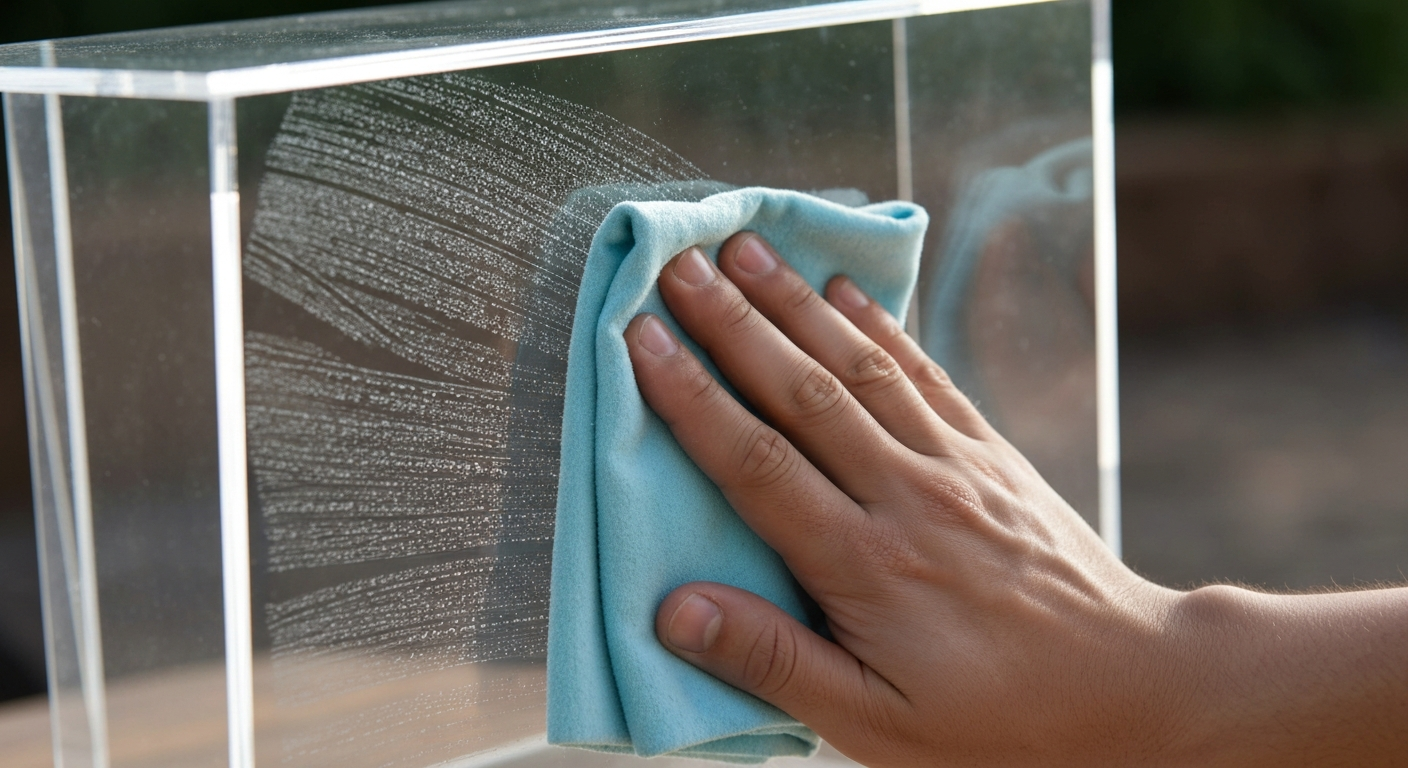
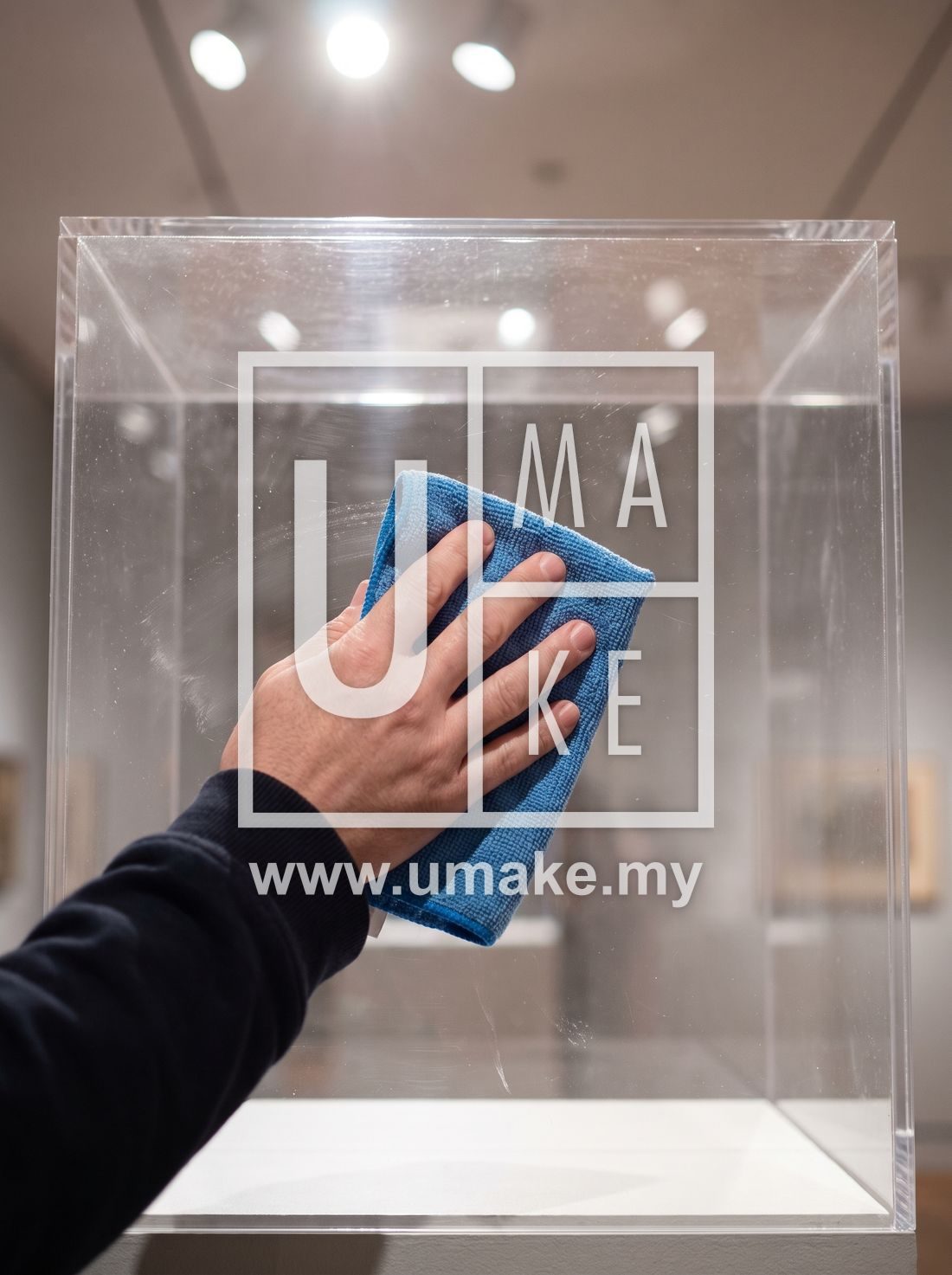
Why Display Cases Get Streaky
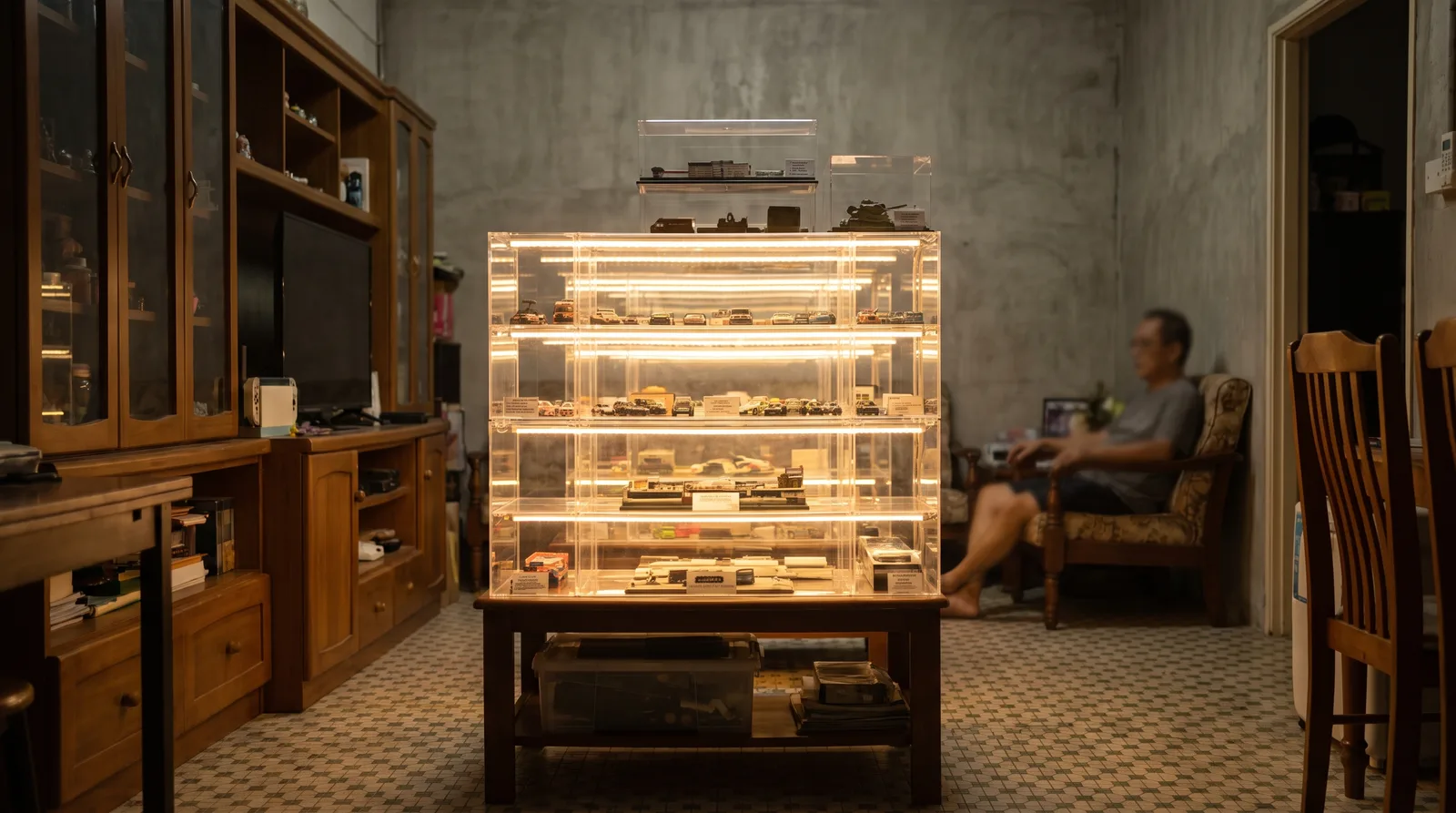
You just cleaned your display case, but somehow it looks worse than before — cloudy streaks, smudge marks, and a hazy film that catches the light at every angle. Sound familiar? You are not alone. Whether you own an acrylic display case or a glass display case, streaks are the number one complaint from collectors and shop owners alike.
Understanding how to clean a display case without streaks starts with knowing what causes them in the first place. Here are the four most common mistakes:
1. Using the Wrong Cleaning Products
Most household glass cleaners contain ammonia, alcohol, or other harsh chemicals. These leave behind a residue film that dries into visible streaks. On acrylic, they are even worse — ammonia-based cleaners can cause permanent yellowing and surface crazing over time.
2. Using the Wrong Cloth
Paper towels, tissues, newspaper, and old t-shirts all leave behind lint, micro-fibres, or ink residue. These get trapped in the cleaning solution and dry into streak patterns. Only high-quality microfiber cloths provide a truly lint-free finish.
3. Spraying Directly onto the Surface
This is the single biggest mistake people make. When you spray cleaner directly onto the display case, the liquid pools in corners and edges, runs down the surface unevenly, and creates thick spots that dry into streaks. The solution drips behind shelves and leaves water marks where it collects.
4. Wiping in Circular Motions
Circular wiping feels thorough, but it actually redistributes dirt and cleaning solution in overlapping patterns. Where circles overlap, you get double layers of moisture that dry unevenly — creating those distinctive swirl-shaped streaks.
The good news: once you understand these causes, achieving a streak-free display case is straightforward. The method works identically for both acrylic and glass, which is one reason we recommend acrylic — same cleaning routine, but the material is lighter, safer, and more forgiving.

What NOT to Use on Your Display Case
Before we cover the right products, here is what you must never use. Some of these damage only acrylic, some damage both materials, and some just leave streaks on everything:
| Product | Problem | Glass | Acrylic |
|---|---|---|---|
| Windex / Ammonia-based cleaners | Yellows and crazes acrylic over time; leaves residue film on both | Streaks | Permanent damage |
| Isopropyl alcohol / Rubbing alcohol | Strips protective coatings; causes micro-cracking on acrylic | Damages coating | Cracks surface |
| White vinegar | Acid etches acrylic surface; safe for glass but leaves smell | OK (but smells) | Etches surface |
| Paper towels / Tissues | Wood fibres leave micro-scratches on both surfaces; lint deposits | Scratches | Worse scratches |
| Newspaper | Ink transfers onto surface; myth that it cleans glass is outdated (modern inks smear) | Ink transfer | Ink transfer + scratches |
| Acetone / Nail polish remover | Dissolves acrylic on contact; safe for glass but unnecessary | OK (overkill) | Destroys material |
Key takeaway: If a product is safe for acrylic, it is safe for glass too. The reverse is not true. This is why we recommend learning the acrylic-safe method — it works perfectly on both materials.
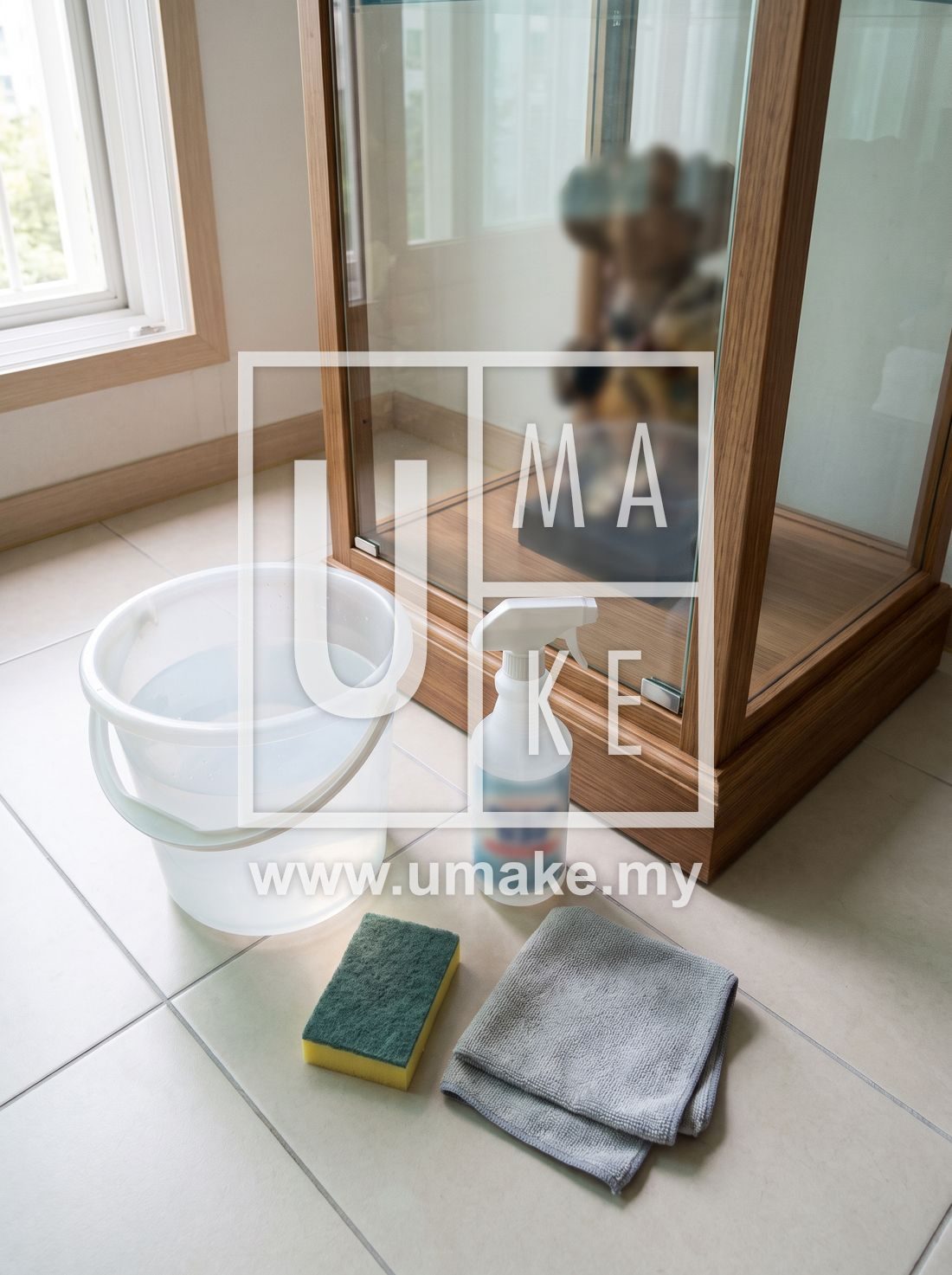
Best Cleaning Products for Display Cases
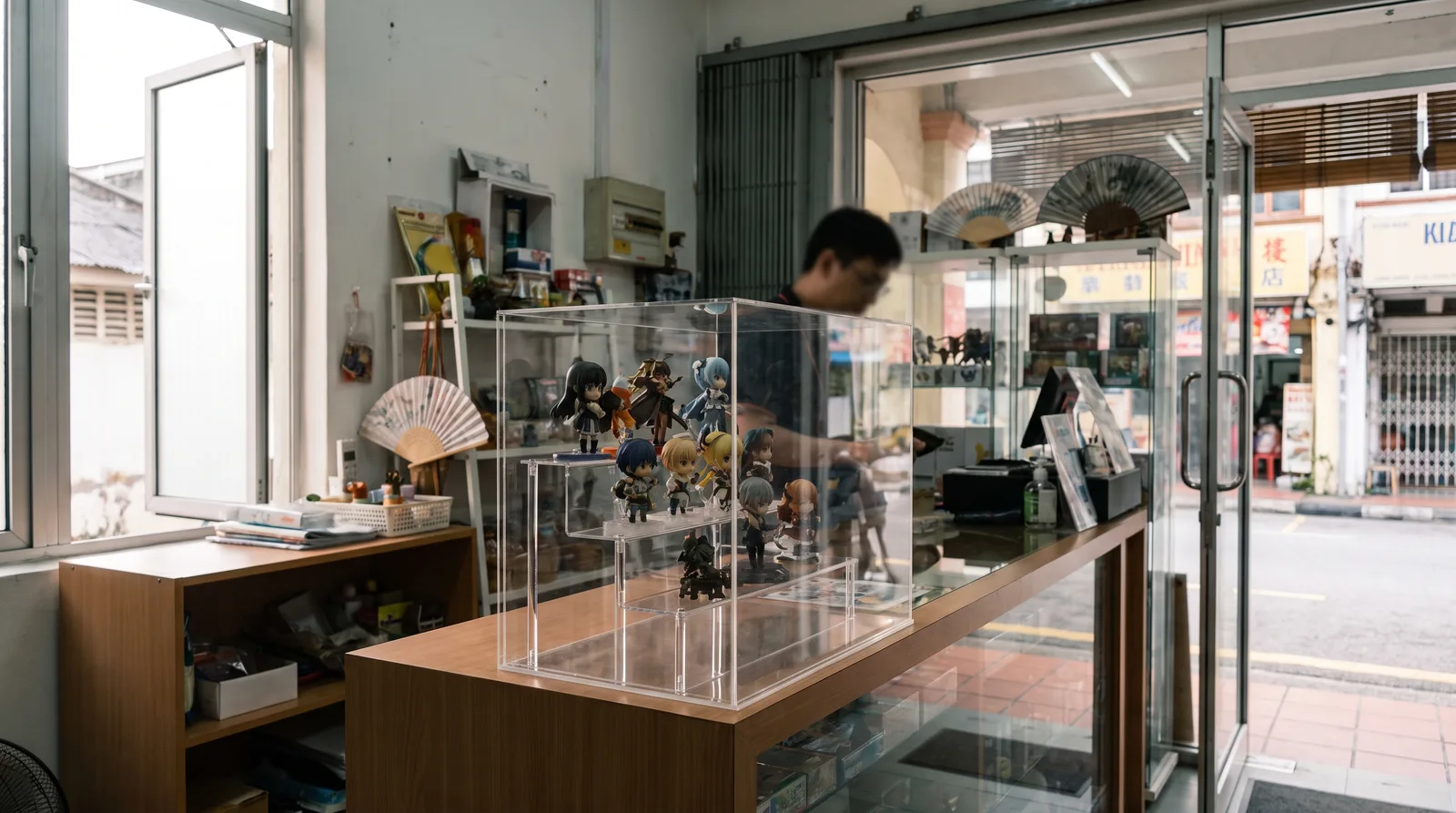
You do not need expensive specialty products to achieve a streak-free display case. Here are the four things that actually work, ranked from best to most budget-friendly:
1. NOVUS #1 Plastic Clean & Shine (Best for Acrylic)
NOVUS #1 is the gold standard for acrylic cleaning. It is specifically formulated to clean without leaving residue, and it deposits an anti-static layer that repels dust. One spray on your cloth, one wipe, and you are done — no buffing needed. The anti-static property means your display case stays cleaner longer between washes.
Where to buy in Malaysia: Shopee and Lazada (search "NOVUS 1 plastic cleaner"). Expect to pay RM35-50 for a 237ml bottle. One bottle lasts 6-12 months with weekly cleaning.
2. Mild Dish Soap + Distilled Water (Budget Option)
If you do not want to buy specialty cleaner, a drop of mild dish soap (like Mama Lemon or Glo) in a bowl of water works well. The key word is mild — no antibacterial formulas, no added fragrances, no "extra grease-cutting power." You want the most basic formula possible.
Use distilled water if you can get it (RM3-5 at any pharmacy). Tap water in Malaysia contains minerals that dry into water spots — this is especially visible on dark-coloured display case backgrounds.
3. Microfiber Cloth (Essential — Do Not Skip)
No matter which cleaning solution you use, the cloth is what determines whether you get streaks. You need at least two microfiber cloths: one damp for cleaning, one dry for buffing. Choose cloths labelled "300 GSM or higher" — thinner ones do not absorb enough moisture.
Where to buy in Malaysia: Mr. DIY (RM5.90 for 3-pack), Shopee (better quality options RM8-15 each), or auto supply shops like AutoCity or Batu Tiga. The yellow or blue generic ones from Mr. DIY work fine for display cases.
4. Compressed Air or Soft Feather Duster (For Dust Removal)
Before any wet cleaning, you must remove loose dust first. If you wipe a dusty surface with a damp cloth, the dust particles act like sandpaper and create micro-scratches. A can of compressed air (RM25-40 at computer shops) or a soft feather duster removes particles without touching the surface.
Pro tip: Keep a can of compressed air next to your display case. A 5-second blast every few days prevents dust build-up and means you only need to do a full wet clean once every 1-2 weeks.
Step-by-Step: Streak-Free Cleaning
This method works for both acrylic display cases and glass display cases. Follow these five steps exactly, and you will never see streaks again:
Need help with Acrylic?
Get a free quote from UMAKE — custom signage designed and manufactured in Malaysia.
Step 1: Remove All Loose Dust
Use compressed air or a soft feather duster to blow off all loose dust and particles. Start from the top and work downward so dust falls away from already-cleaned areas. Pay extra attention to corners, edges, and shelf grooves where dust accumulates.
Why this matters: Dust particles are abrasive. If you skip this step and go straight to wiping, you are essentially dragging sandpaper across your display case surface. On acrylic, this creates visible scratches within weeks. On glass, it causes micro-abrasions that scatter light and make the surface look perpetually hazy.
Step 2: Spray Cleaner ON THE CLOTH, Not on the Case
This is the most important rule for streak-free cleaning. Spray your cleaning solution onto the microfiber cloth until it is damp but not dripping. Never spray directly onto the display case surface.
Why? When you spray directly on the surface:
- Liquid runs down and pools at the bottom edge
- Solution seeps into joints and seams where it cannot be wiped away
- You apply too much product in some areas and not enough in others
- Overspray mists onto already-clean adjacent panels
Spraying on the cloth gives you even distribution across the entire surface with every wipe. This single habit eliminates 80% of streak problems.
Step 3: Wipe in Long Straight Strokes
Starting from the top of the panel, wipe in long straight horizontal strokes from one edge to the other. Move down slightly with each pass, overlapping the previous stroke by about 1cm. Never wipe in circles.
Straight strokes ensure even pressure distribution and prevent the overlapping moisture patterns that cause circular streak marks. Think of it like painting a wall — you would never paint in random circles.
Step 4: Flip the Cloth and Buff Dry
Immediately after wet-wiping a panel, flip your microfiber cloth to the dry side and repeat the same straight strokes over the same area. This removes any remaining moisture before it can dry into streaks. Do not wait — the faster you buff dry after wet wiping, the better the result.
If your cloth is too saturated, switch to your second dry microfiber cloth. A wet "dry side" defeats the purpose of this step.
Step 5: Final Polish with a Clean Dry Microfiber
Once the entire case is cleaned and buffed, take a fresh dry microfiber cloth and do one final pass over all surfaces. Use very light pressure — you are just catching any remaining micro-moisture that the buffing step missed. This step gives that showroom-quality crystal clarity.
Optional: If you used NOVUS #1, you can skip this step because it dries streak-free on its own. But for the dish soap method, this final polish makes a noticeable difference.
How to Remove Scratches from Acrylic Display Cases
One major advantage of acrylic over glass: scratches are repairable. A scratched glass panel needs full replacement, but acrylic scratches can be polished out at home. Here is how:
Light Scratches (Fingernail Does Not Catch)
For fine surface scratches, swirl marks, or haze from improper cleaning:
- Clean the area thoroughly using the method above
- Apply a small amount of NOVUS #2 Fine Scratch Remover to a clean microfiber cloth
- Rub in straight lines (not circles) with moderate pressure for 30-60 seconds
- Wipe away residue with a clean cloth
- Repeat if needed — most light scratches disappear in 1-2 applications
NOVUS #2 is available on Shopee and Lazada for RM40-60. One bottle lasts years since you only need a few drops per session.
Medium Scratches (Fingernail Catches Slightly)
For deeper scratches that you can feel but cannot see a clear groove:
- Start with NOVUS #3 Heavy Scratch Remover on a microfiber cloth
- Work the scratch with firm straight strokes for 2-3 minutes
- Follow up with NOVUS #2 to restore clarity
- Finish with NOVUS #1 for final polish
Deep Scratches (Visible Groove)
For gouges and deep scratches, you need wet sanding:
- Start with 2000 grit wet/dry sandpaper, soaked in water
- Sand in one direction only (with the grain of the scratch) for 2-3 minutes
- Move to 3000 grit, then 5000 grit — each for 2-3 minutes
- The surface will look cloudy — this is normal
- Apply NOVUS #3, then #2, then #1 to restore full clarity
When to replace vs repair: If scratches cover more than 30% of a panel, or if there are cracks (not just scratches), replacement is more practical. UMAKE acrylic display cases use individual panels that can be replaced separately — you do not need to buy an entirely new case.
Acrylic vs Glass: Cleaning Differences
The good news: the basic cleaning method is identical for both materials. Mild soap + microfiber + straight strokes works perfectly on acrylic and glass alike. But there are meaningful differences in how the two materials behave during and after cleaning:
Why We Recommend Acrylic for Most Display Cases
| Factor | Acrylic | Glass |
|---|---|---|
| Weight | 50% lighter — easy to lift and move for cleaning all sides | Heavy — awkward to handle, especially large cases |
| Drop risk during cleaning | Will not shatter — might scratch but won't break | Shatters into dangerous shards |
| Scratch repair | Scratches can be polished out completely at home | Scratches are permanent — panel must be replaced |
| Scratch resistance | Softer — scratches more easily if wrong cloth used | Harder — more resistant to everyday scratches |
| Chemical sensitivity | Sensitive to ammonia, alcohol, acetone | Resistant to most household chemicals |
| Static charge | Builds static (attracts dust) — anti-static cleaner solves this | Minimal static charge |
| Clarity | 92% light transmission (clearer than glass) | 90% light transmission |
Bottom line: Both materials clean the same way. But acrylic is lighter (so you actually clean it more often because it is not a chore to move), will not shatter if you drop a panel while cleaning, and any accidental scratches can be fixed. For most collectors displaying collectible items, LEGO sets, or figurines, acrylic is the practical winner.
If you are choosing between the two materials, our detailed comparison at Acrylic vs Glass: Which is More Durable? covers everything from UV resistance to long-term clarity.
Malaysia-Specific Tips for Display Case Care
Living in a tropical climate adds unique challenges to keeping your display case clean. Here are tips specifically for Malaysian conditions:
Humidity and Condensation
Malaysia's average humidity of 70-90% causes condensation to form on display case surfaces, especially:
- When aircon is turned off at night and temperatures rise
- When cold airconditioned air meets warm exterior panels
- During monsoon season (October-March) when humidity peaks
Solution: Wipe your display case with a dry microfiber cloth at least once a week to prevent mineral build-up from condensation. If you notice water droplets forming regularly, consider placing silica gel packets inside the case to absorb excess moisture.
Air-Conditioned Rooms Are Your Friend
Display cases in air-conditioned rooms stay cleaner significantly longer. The controlled humidity prevents condensation, and the filtered air contains less dust. If you have valuable collectibles, keeping them in an aircon room reduces cleaning frequency from weekly to bi-weekly.
Tropical Dust Is Oilier
Dust in Malaysia is not the same as dust in temperate countries. Our tropical dust contains more pollen, cooking oil particles (if near a kitchen), and moisture-bound debris. This means dry dusting alone is not enough — you need the soap-and-water method to cut through the oily film that builds up.
If you live near a main road or construction site, expect to clean more frequently. Traffic pollution and construction dust leave a greasy residue that dry cloths just push around.
Avoid Direct Sunlight
Both acrylic and glass display cases should be kept away from direct sunlight. UV exposure causes:
- Acrylic: Yellowing over 3-5 years (high-quality cast acrylic resists this better)
- Glass: No yellowing, but UV damages the items inside
- Both: Heat build-up inside the case can damage figurines, cards, and other collectibles
Position your display case away from windows, or use UV-filtering curtains. If your acrylic case has already yellowed slightly, NOVUS #2 can sometimes restore partial clarity, but prevention is better than cure.
Cleaning Schedule for Malaysia
| Location | Dust (Dry) | Full Clean (Wet) |
|---|---|---|
| Air-conditioned room | Every 3-4 days | Every 2 weeks |
| Non-aircon room | Every 1-2 days | Weekly |
| Near kitchen / open windows | Daily | Every 3-5 days |
| Retail shop / high traffic | Daily | Every 2-3 days |
Frequently Asked Questions
Can I use Windex on my acrylic display case?
No. Windex and other ammonia-based glass cleaners will damage acrylic over time. They cause yellowing, surface hazing, and micro-cracks (crazing) that cannot be repaired. Use NOVUS #1 or mild dish soap with water instead. These products work safely on both acrylic and glass.
How often should I clean my display case in Malaysia?
In air-conditioned rooms, a full wet clean every 2 weeks is sufficient, with light dusting every 3-4 days. In non-aircon rooms or humid environments, clean weekly. Malaysia's high humidity and tropical dust mean display cases get dirty faster than in temperate climates. A quick 30-second dust with compressed air every few days prevents the need for frequent deep cleaning.
Why does my display case always look hazy even after cleaning?
This is almost always caused by one of three things: (1) using a cleaning product that leaves residue (switch to NOVUS #1 or plain soap and water), (2) using tap water instead of distilled water (minerals dry into a hazy film), or (3) not buffing dry immediately after wet wiping. Try the full five-step method above and you should see immediate improvement.
Is acrylic or glass easier to keep clean?
The cleaning method is identical for both. However, acrylic is easier to maintain because it is lighter (so you actually move it to clean all sides) and will not shatter if you accidentally drop a panel. Glass is more scratch-resistant, so it forgives slightly rougher wiping. For most home collectors, acrylic is the more practical choice overall.
Can I remove deep scratches from my acrylic display case?
Yes — this is a major advantage of acrylic over glass. Light scratches disappear with NOVUS #2 polish. Medium scratches need NOVUS #3 followed by #2. Deep gouges require wet sanding with progressive grits (2000, 3000, 5000) followed by polishing. Glass scratches are permanent and require panel replacement.
Get a New Streak-Free UMAKE Display Case
If your current display case is beyond saving — too scratched, yellowed, or cracked — it might be time for an upgrade. UMAKE acrylic display cases are laser-cut from premium cast acrylic for maximum clarity, and they are designed for easy cleaning with removable panels.
Browse our full range of acrylic display cases and storage solutions, or check out our best-selling stackable display case — perfect for figurines, LEGO, and collectibles.
Need help choosing the right display case? Chat with us directly:
Factory in Balakong, Selangor. Custom sizes available. Wholesale pricing for shops and retailers.


