In 2023, Malaysia recorded 38,950 occupational injury cases and 324 workplace fatalities, according to the Department of Statistics Malaysia. Many of these incidents could have been prevented with proper safety signage — clear, visible signs that warn workers of hazards, direct them to exits, and remind them to wear protective equipment.
If you manage a factory, warehouse, office, or construction site in Malaysia, safety signs are not optional. They are a legal requirement under the Occupational Safety and Health Act 1994 (OSHA 1994), enforced by the Department of Occupational Safety and Health (DOSH). Non-compliance can result in fines up to RM500,000 or imprisonment.
This guide covers the 5 categories of safety signs recognised under Malaysian Standard MS 2558:2022 and ISO 7010, what the law requires, where to place them, and how to choose signs that last in Malaysia's humid climate.
The 5 Categories of Safety Signs in Malaysia
Malaysian Standard MS 2558:2022 (Safety and Health Signage Used in the Workplace) classifies safety signs into five categories based on their purpose, shape, and colour. This standard aligns with the international ISO 7010 and ISO 3864 standards for graphical safety symbols.
1. Prohibition Signs (Red Circle with Diagonal Line)
Purpose: Indicate actions or behaviours that are strictly forbidden in a specific area.
Design: Round shape with a red circle and diagonal bar over a black pictogram on a white background. The red portion must cover at least 35% of the sign area.
Common examples in Malaysian workplaces:
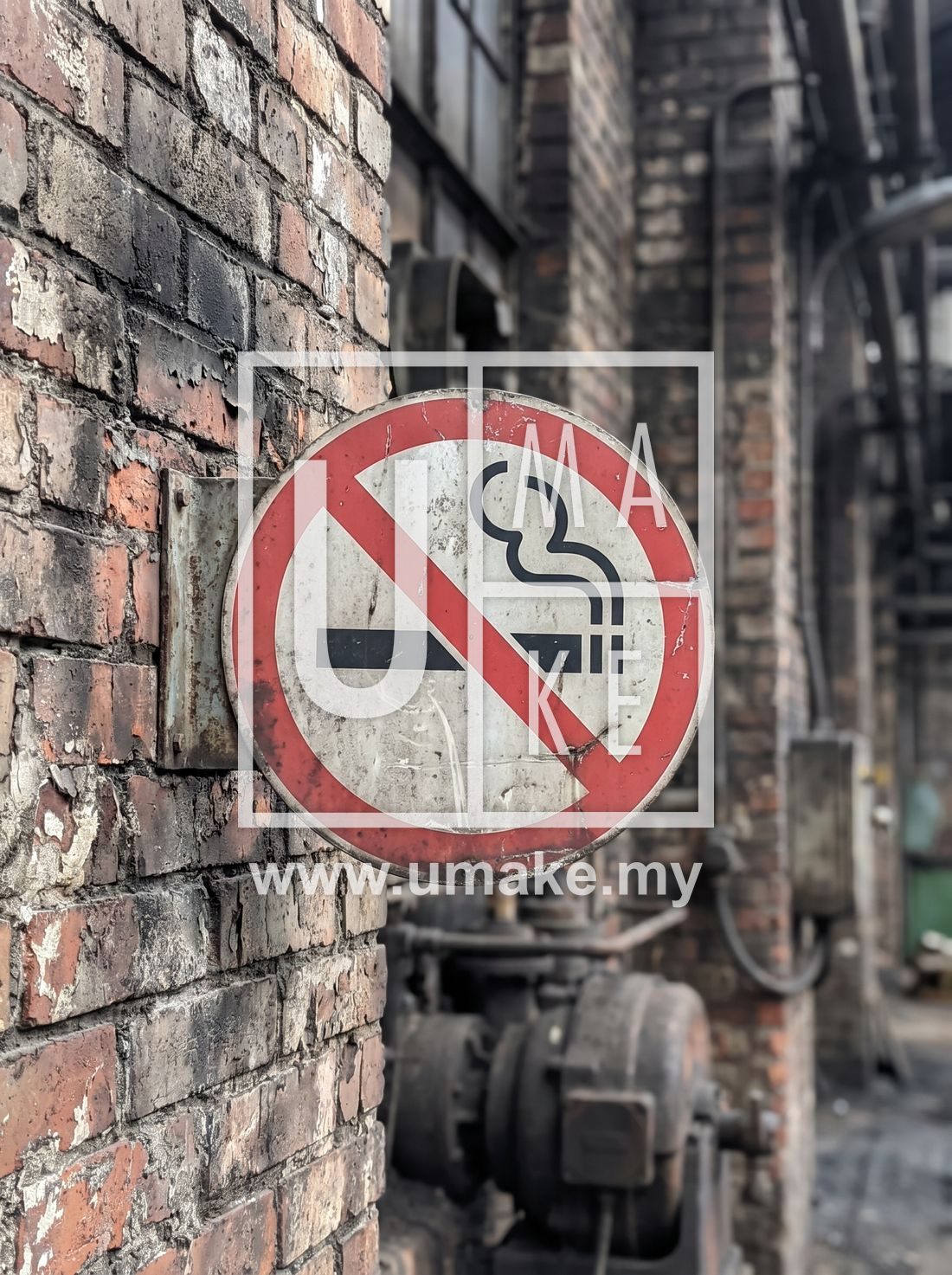
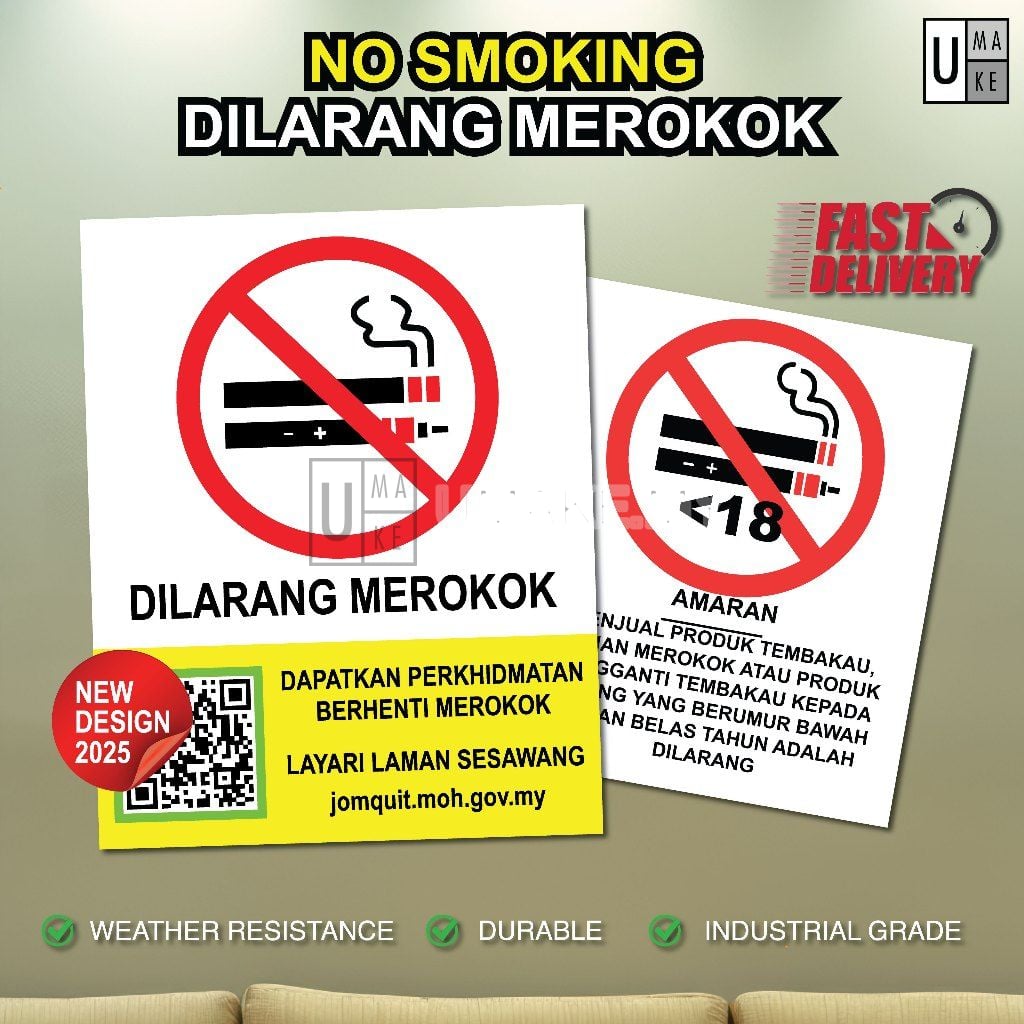
- No Smoking / No Vaping — Required under the Control of Tobacco Products Regulations 2004 and Akta 852 (Control of Smoking Products for Public Health Act 2024) in all enclosed public spaces, workplaces, and within designated zones
- No Entry / Dilarang Masuk — Restricted machinery areas, electrical rooms, server rooms
- No Photography — Sensitive production areas
- No Open Flames — Near flammable storage
A standard no-entry prohibition sign — the red circle with diagonal line is universally recognised in Malaysian workplaces.
A no-smoking sign displayed on a glass door — required in all enclosed public spaces and workplaces under Akta 852.
2. Warning Signs (Yellow Triangle)
Purpose: Alert workers and visitors to potential hazards or dangerous conditions in the area.
Design: Triangular shape with a yellow background, black border, and black pictogram. The yellow portion must cover at least 50% of the sign area.
Common examples in Malaysian workplaces:
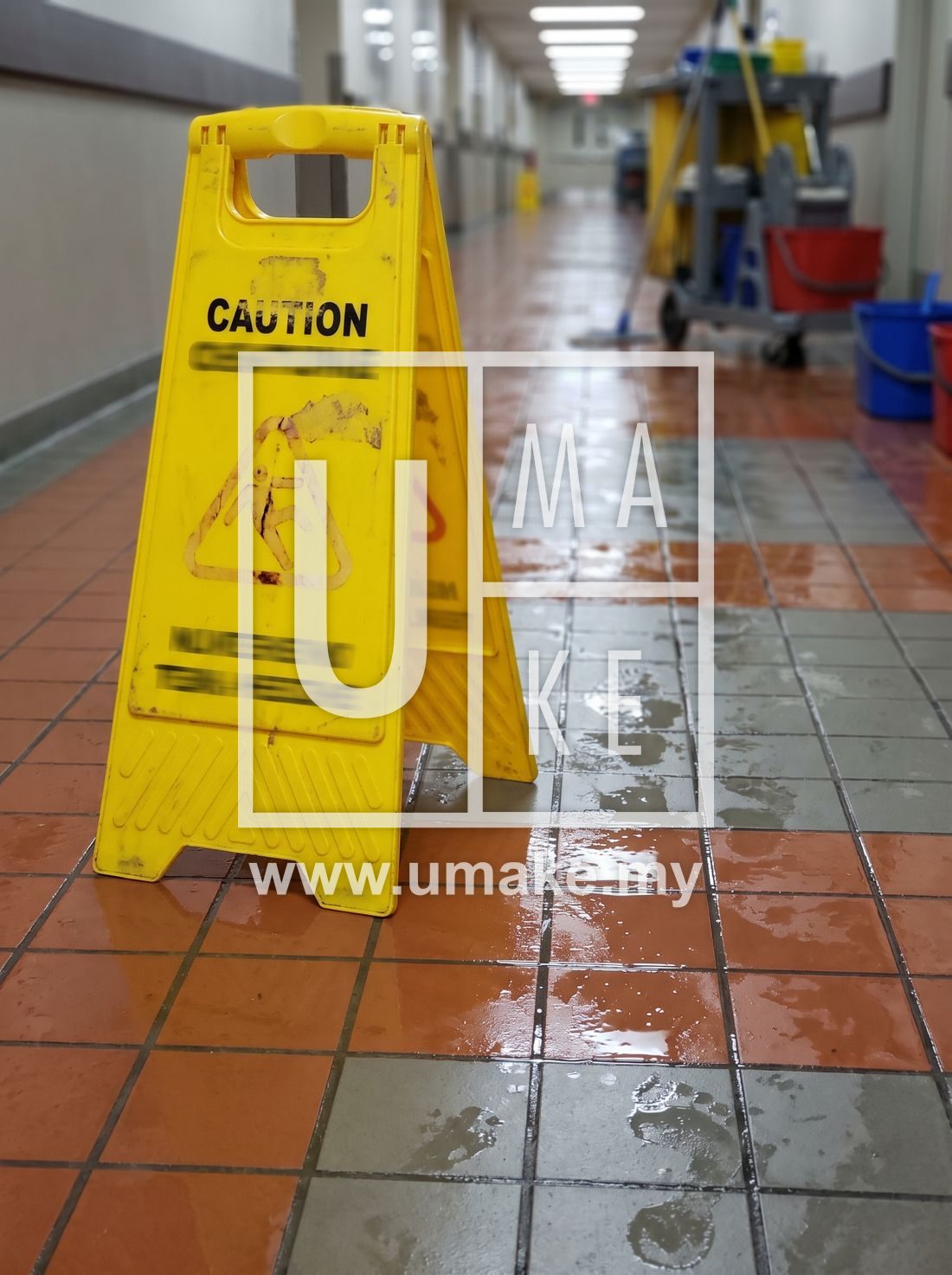
- Awas Lantai Licin / Caution Wet Floor — Lobbies, kitchens, factory floors after cleaning
- Awasi Langkah Anda / Watch Your Step — Staircases, uneven floors, loading docks
- Bahaya / Danger (High Voltage) — TNB electrical panels, transformer rooms, switchboard areas
- Caution: Forklift Operating Area — Warehouses and factories
- Chemical Hazard — Storage areas with hazardous substances under CLASS Regulations 2013
Warning signs at a building entrance — yellow triangular signs alert workers and visitors to potential hazards before they encounter them.
3. Mandatory Signs (Blue Circle)
Purpose: Specify an instruction that must be carried out. These signs tell workers what protective equipment or actions are required before entering an area.
Design: Circular shape with a blue background and white pictogram. The blue portion must cover at least 50% of the sign area.
Common examples in Malaysian workplaces:
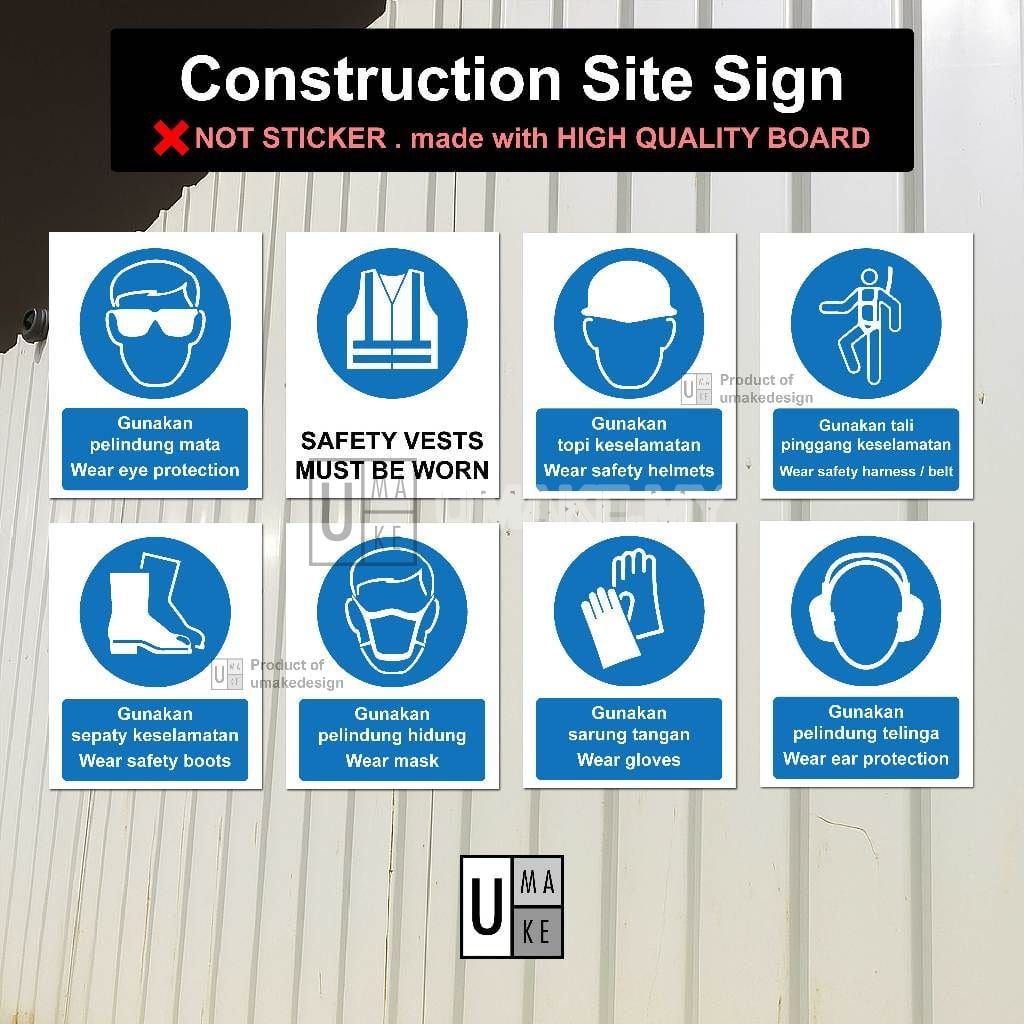
- Pakai PPE / Wear Personal Protective Equipment — Construction sites, factories, chemical handling areas
- Hard Hat Area / Kawasan Topi Keselamatan — Construction sites (mandatory under OSHA 1994)
- Safety Glasses Required — Welding areas, grinding stations, laser cutting zones
- Wear Safety Boots — Warehouses, workshops, loading areas
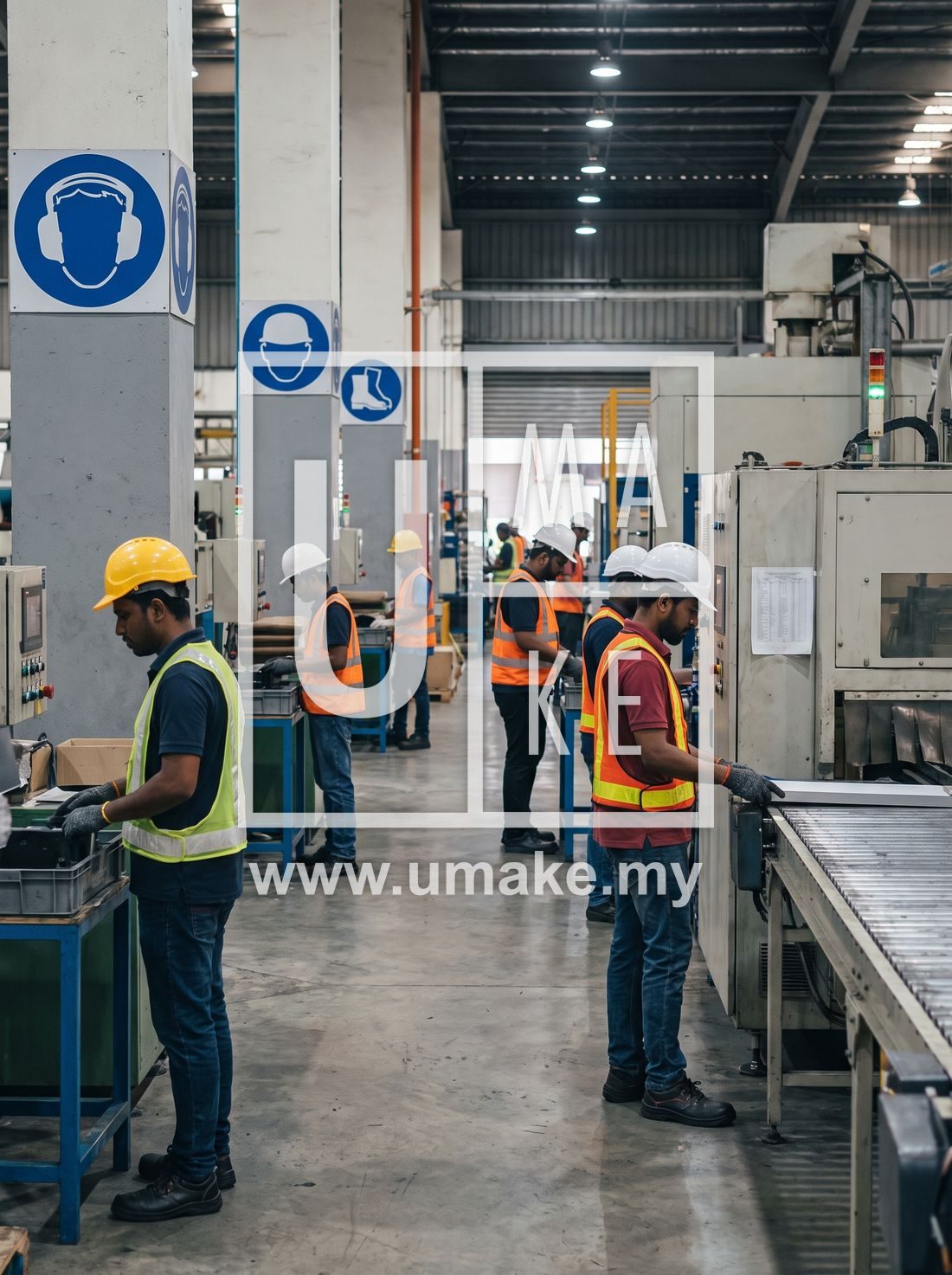
- Ear Protection Required — Factories exceeding 85 dB(A) noise levels (Factories and Machinery (Noise Exposure) Regulations 1989)
Construction workers at a building site — one of the most common environments where mandatory PPE signs (hard hats, safety boots, high-visibility vests) are legally required.
4. Emergency / Safe Condition Signs (Green Rectangle)
Purpose: Indicate the location of safety equipment, emergency exits, first aid facilities, and assembly points. These are the signs people rely on during emergencies.
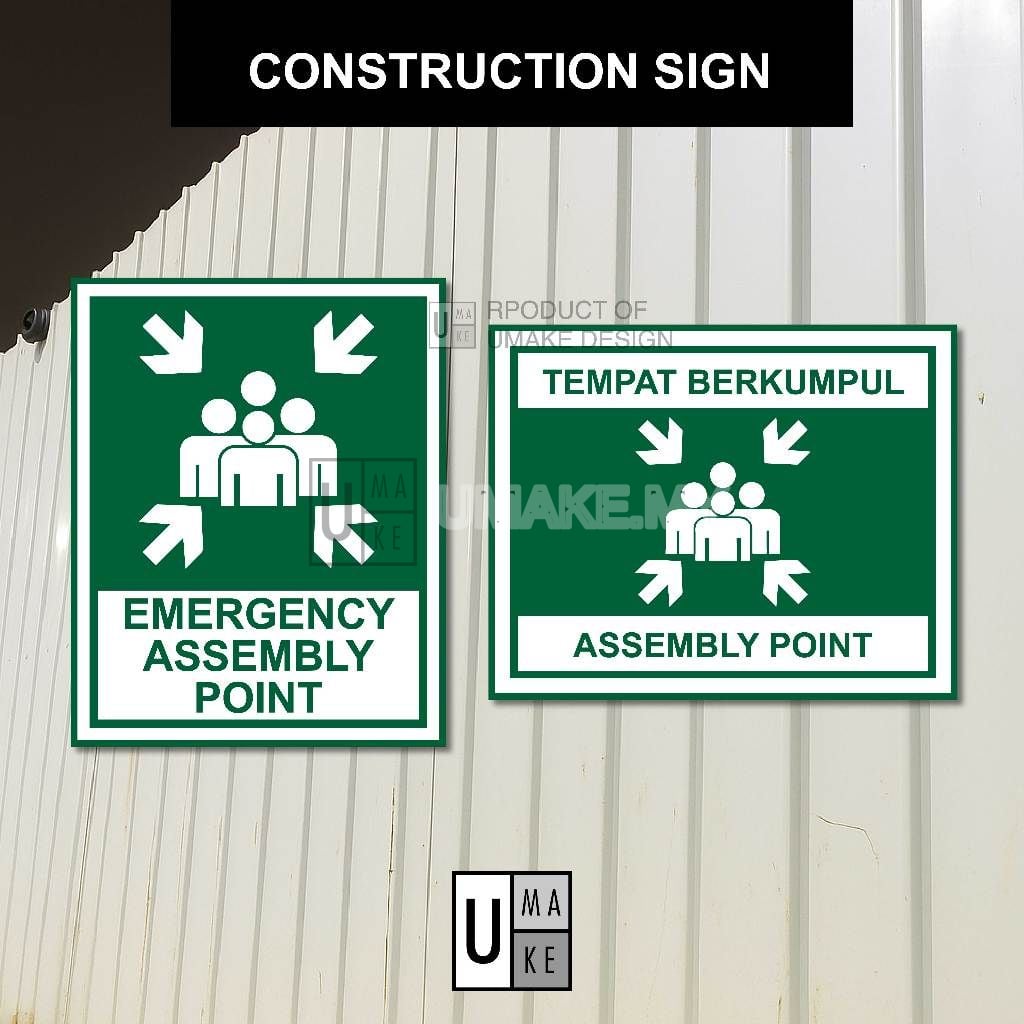
Design: Rectangular or square shape with a green background and white pictogram or text. The green portion must cover at least 50% of the sign area.
Common examples in Malaysian workplaces:
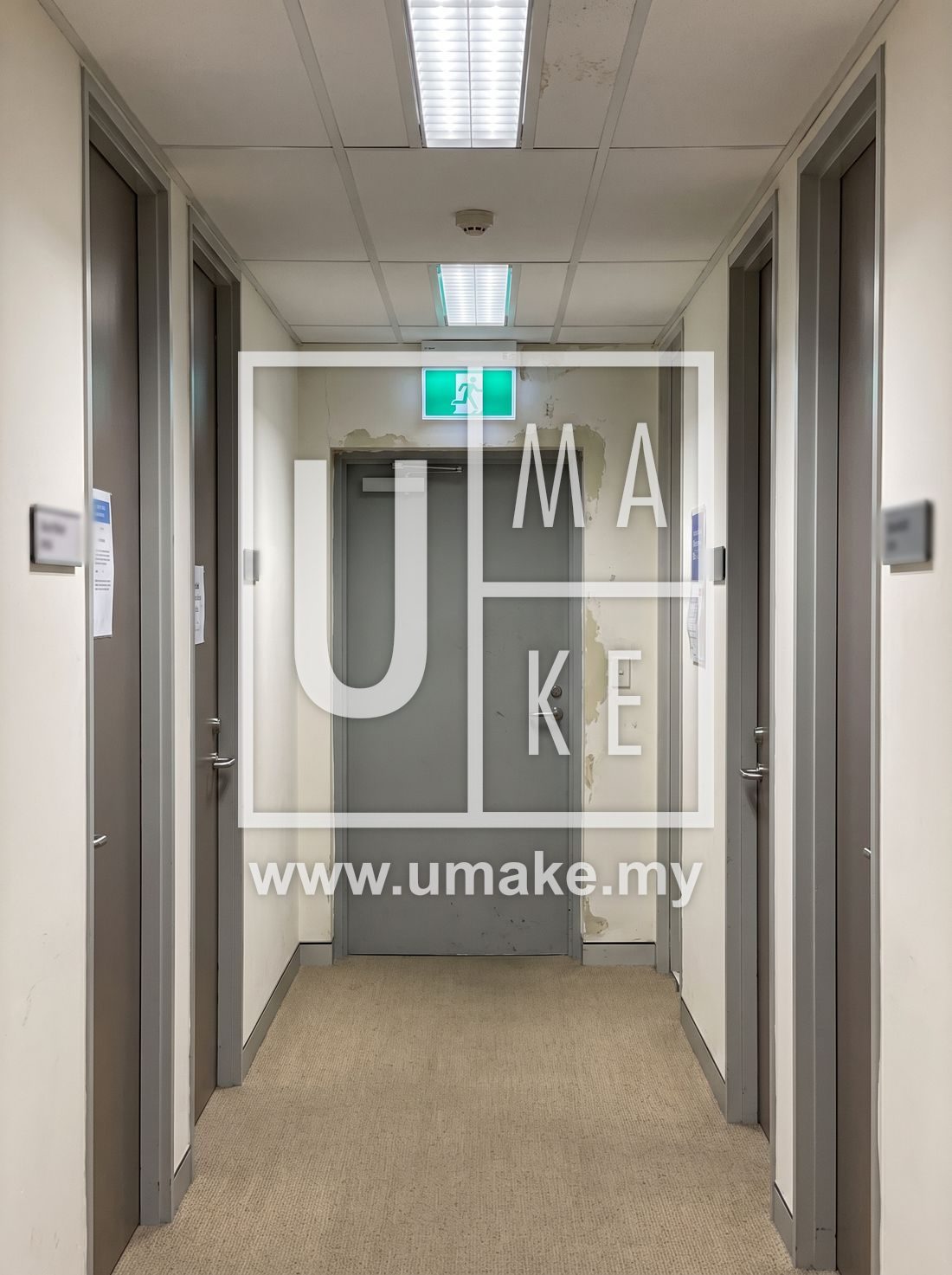
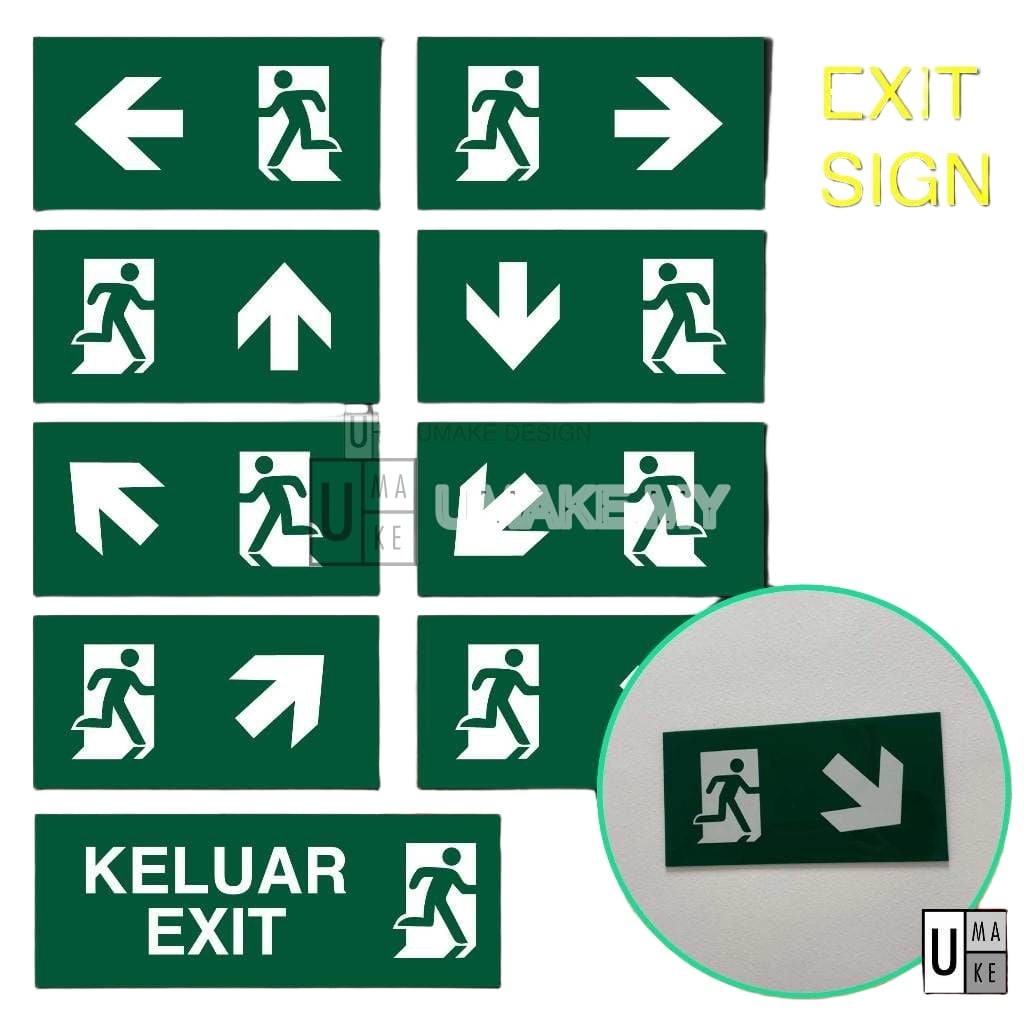
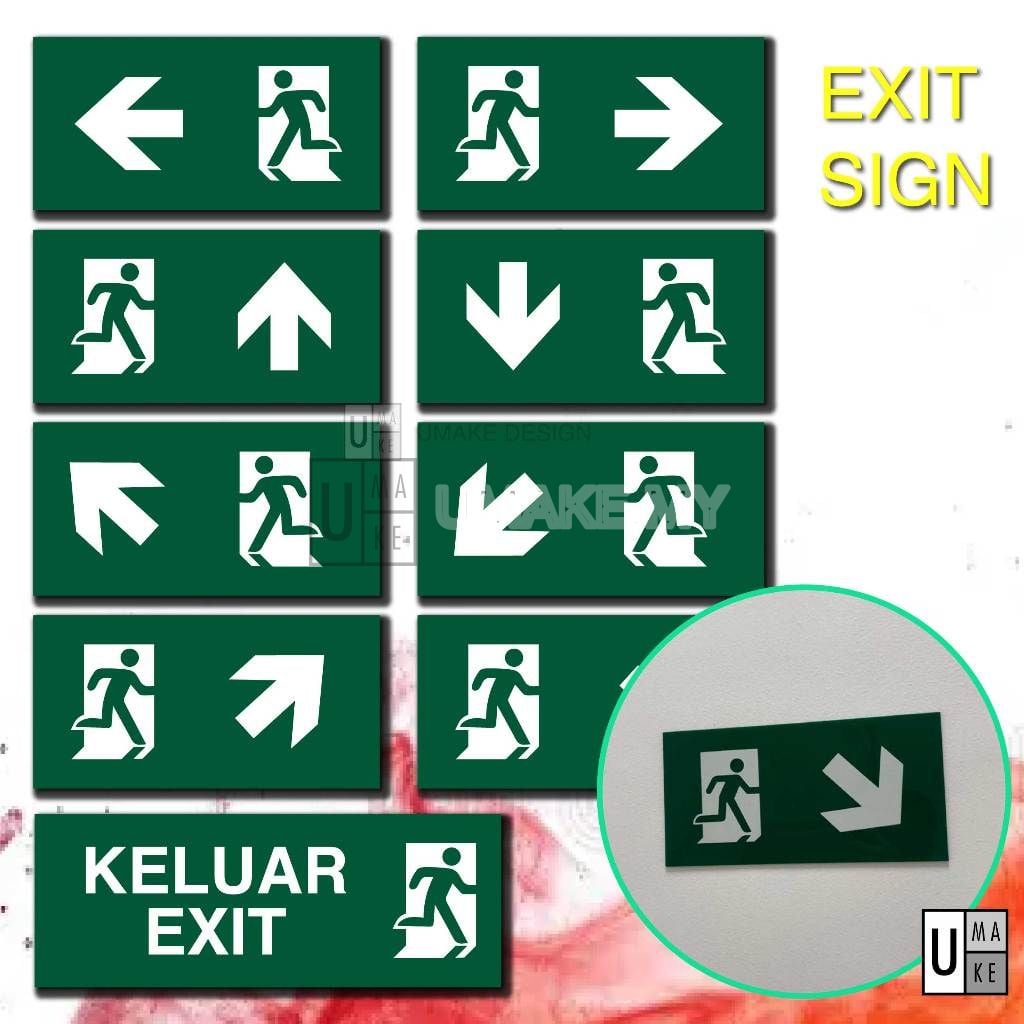
- Keluar / Exit — Must be illuminated at all times under the Fire Services Act 1988 and Uniform Building By-Laws 1984 (UBBL). The word "KELUAR" is mandatory in Malaysia
- First Aid / Pertolongan Cemas — Location of first aid kits and stations
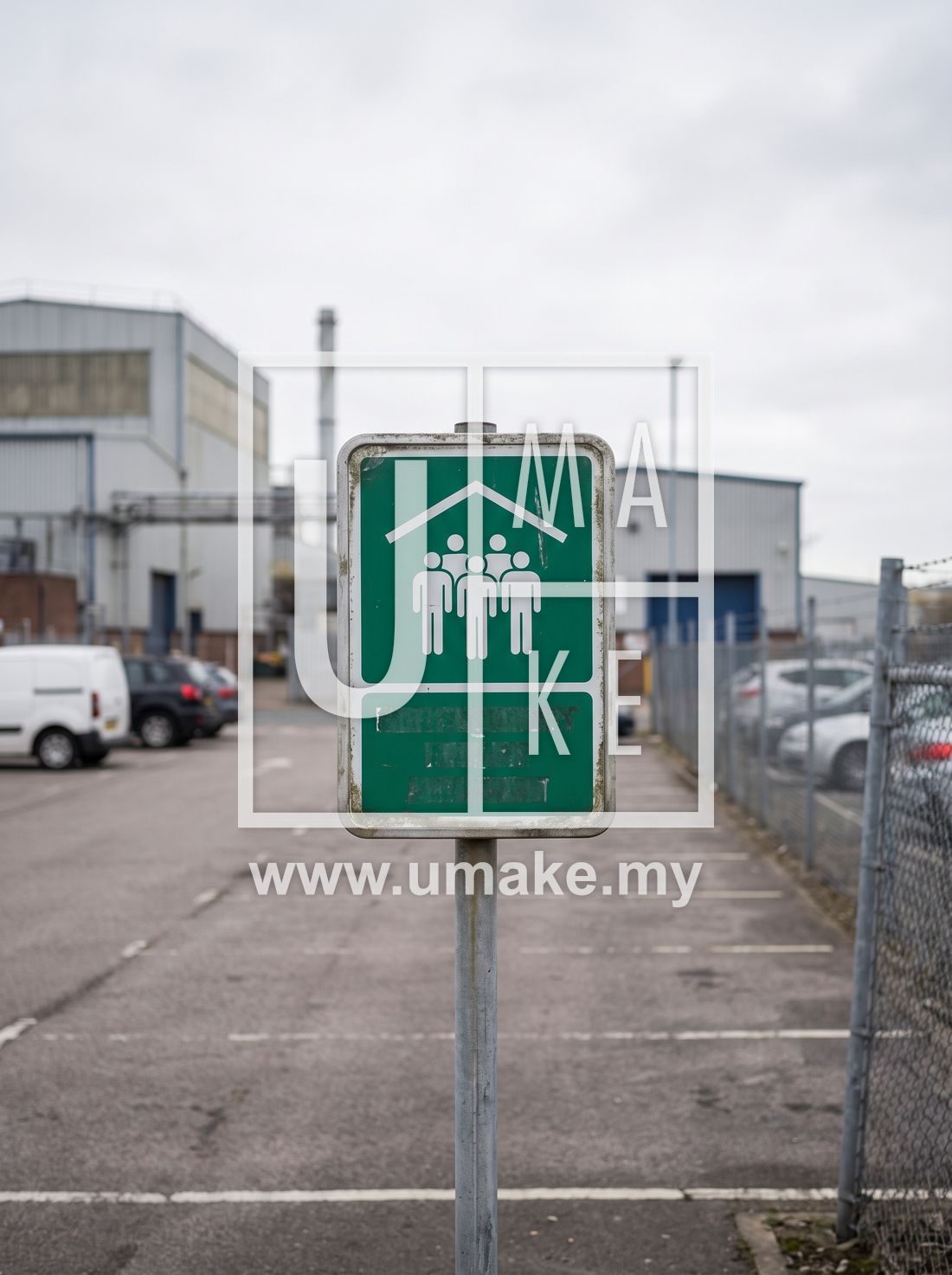
- Emergency Assembly Point / Tempat Berkumpul Kecemasan — Designated gathering areas during evacuations
- Emergency Shower / Eyewash Station — Chemical handling areas
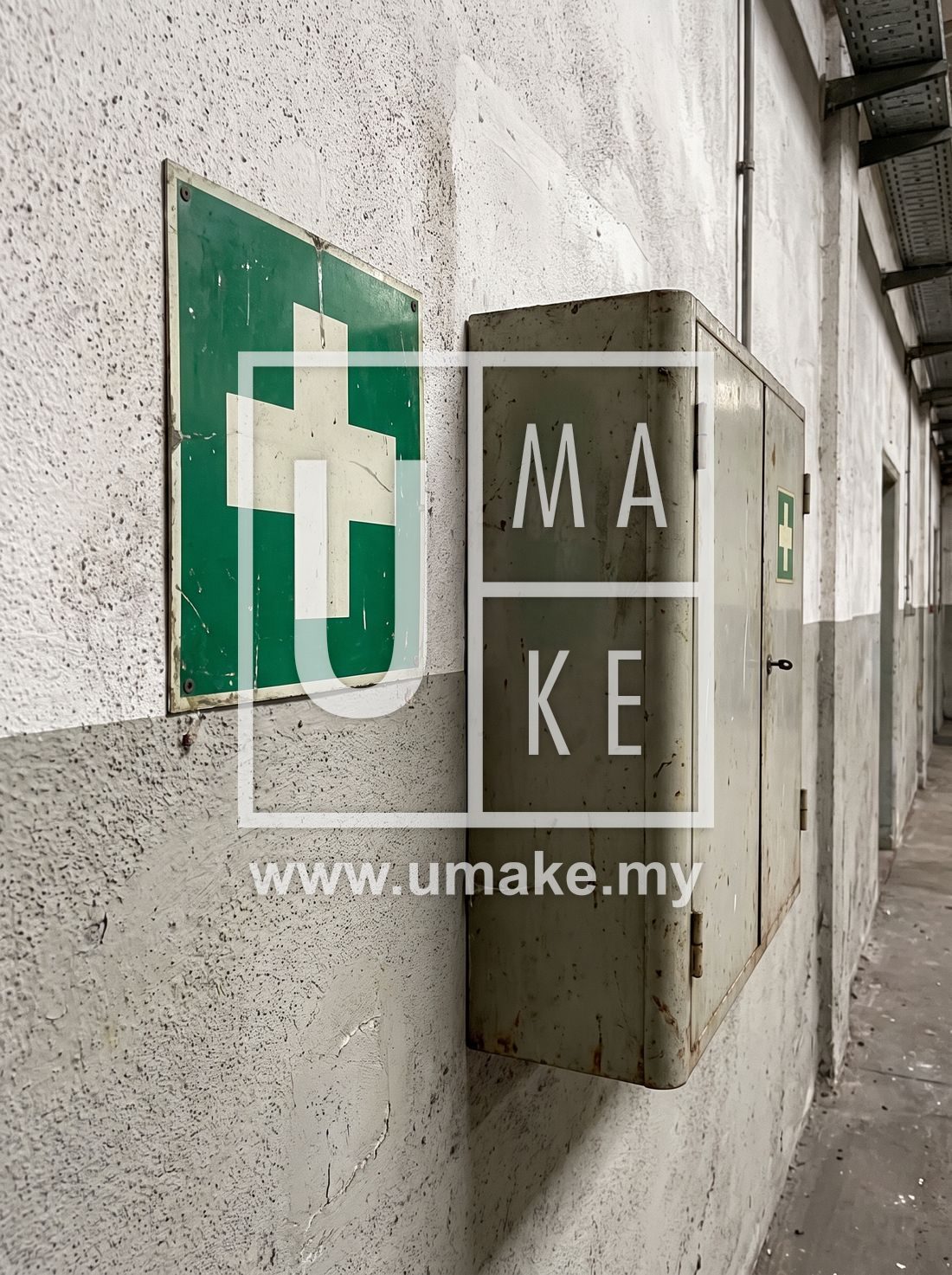
A green emergency exit sign with the running person icon — these illuminated signs must be visible at all times and include the word "KELUAR" in Malaysia.
A fire extinguisher positioned next to a green exit sign — emergency and fire safety signage working together in a real building corridor.
5. Fire Safety Signs (Red Rectangle)
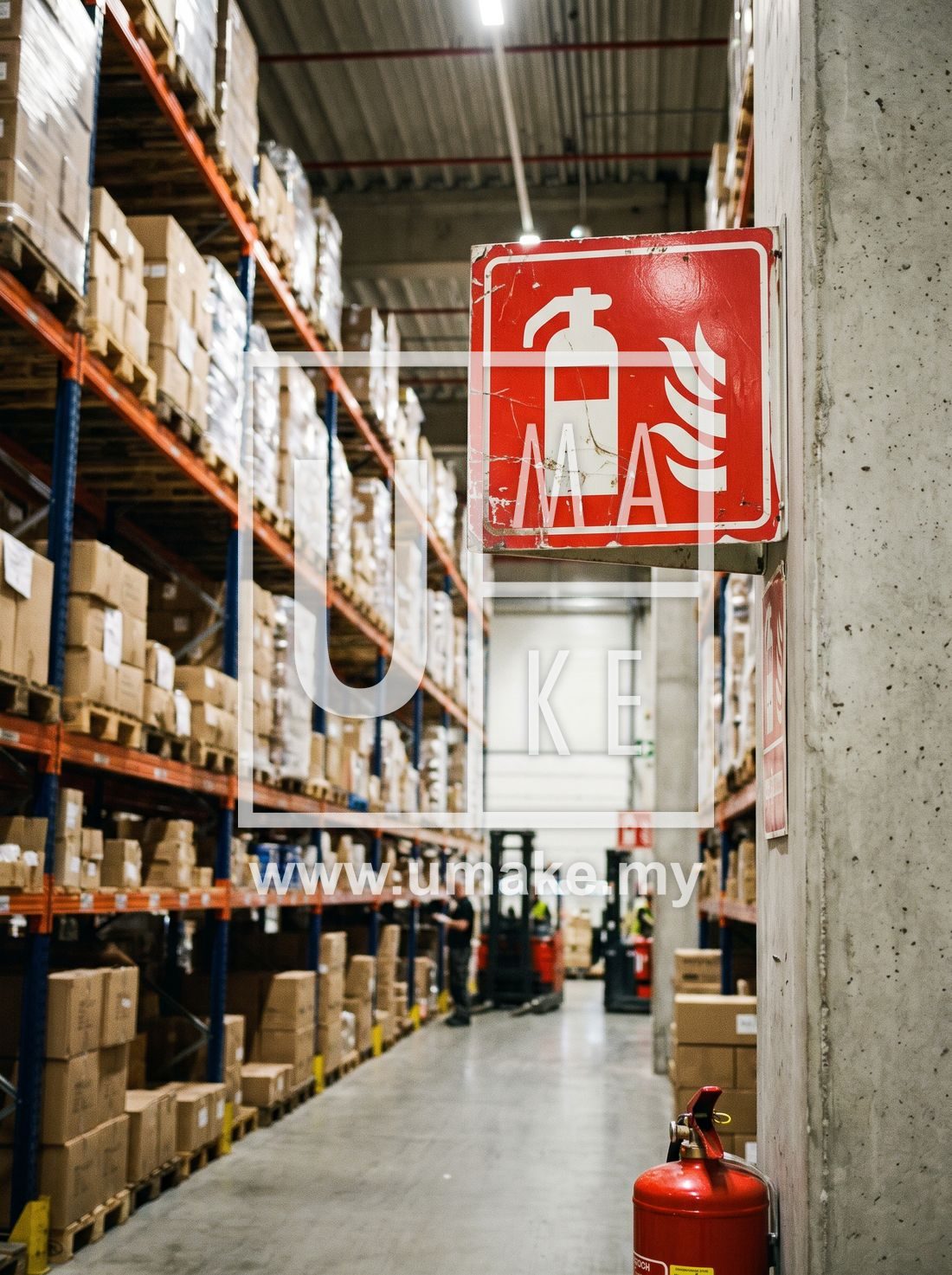
Purpose: Indicate the location of fire-fighting equipment such as extinguishers, hose reels, fire alarms, and fire blankets. Regulated under the Fire Services Act 1988 and enforced by BOMBA (Malaysia Fire and Rescue Department).
Design: Rectangular or square shape with a red background and white pictogram. Distinct from prohibition signs because they have no diagonal bar.
Common examples in Malaysian workplaces:
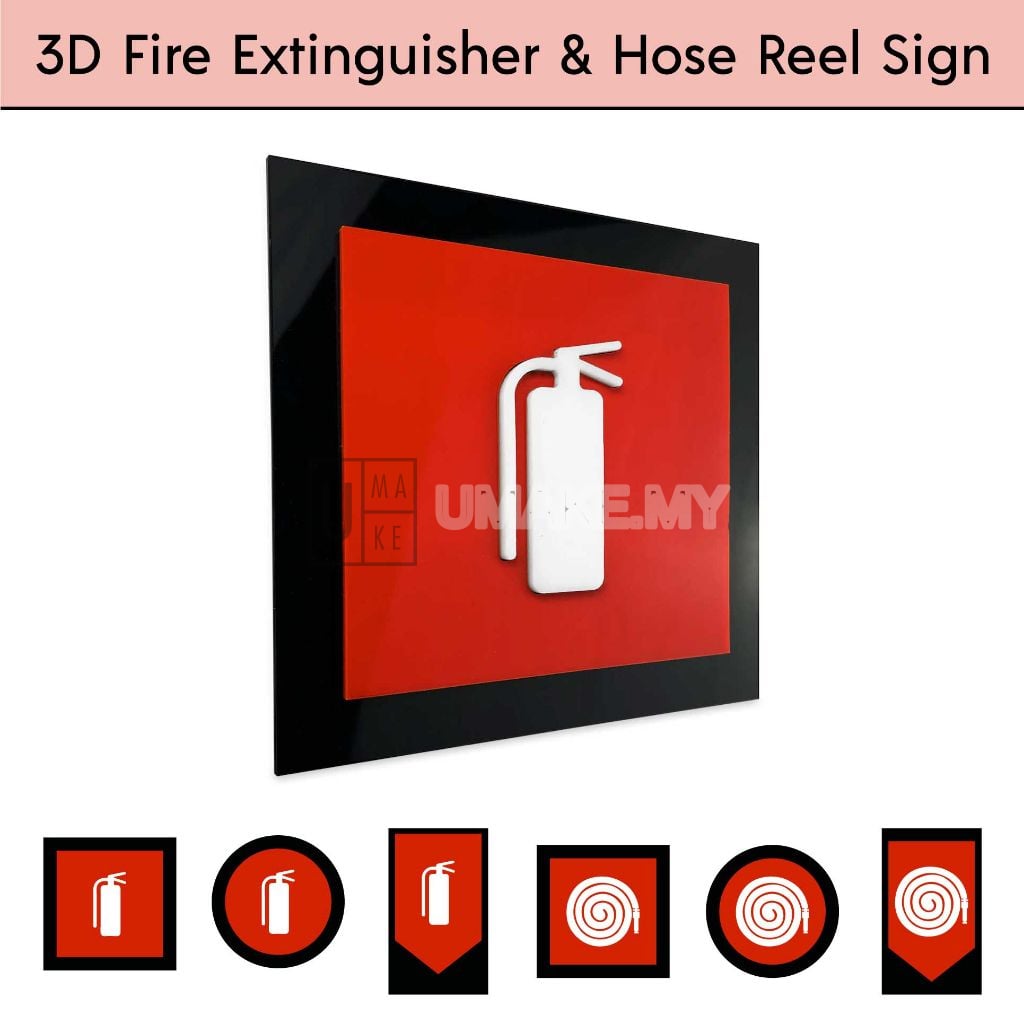
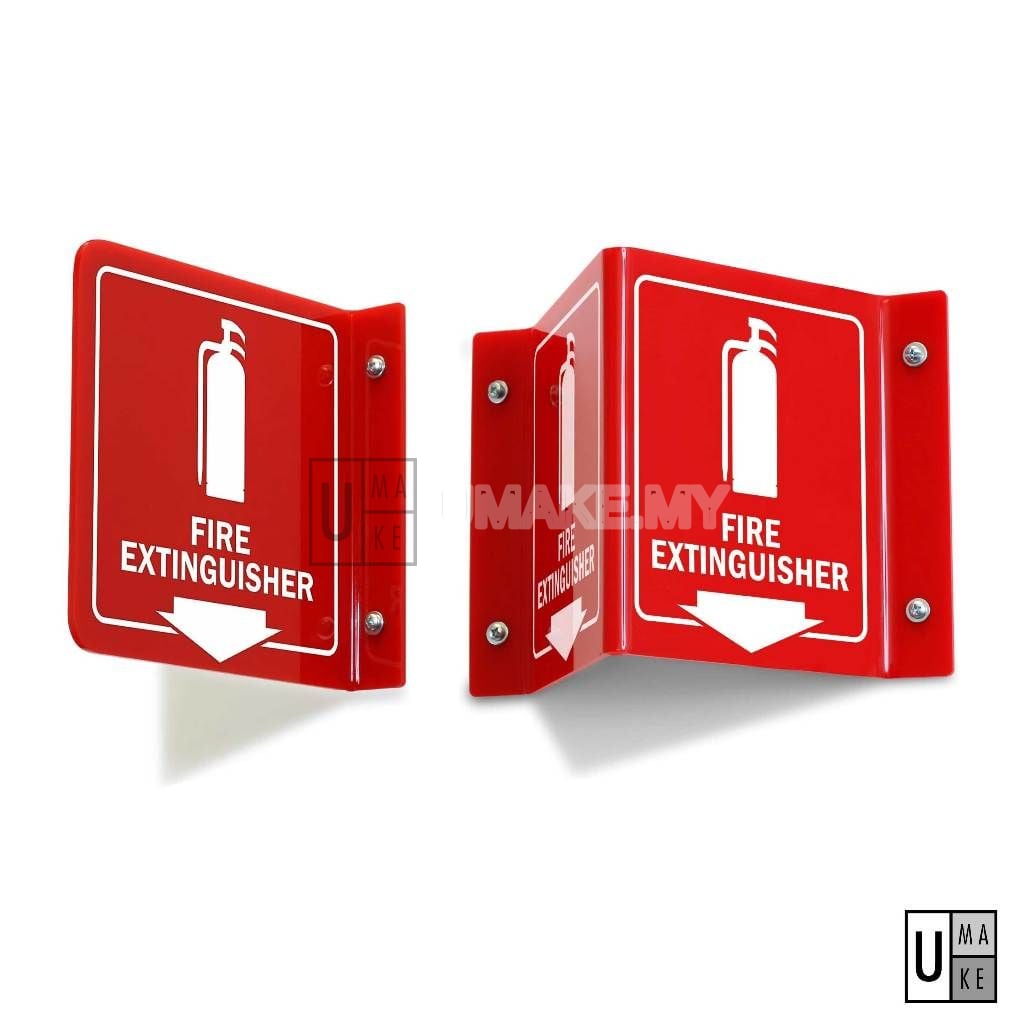
- Pemadam Api / Fire Extinguisher — Must be placed at every extinguisher location with directional arrows if needed
- Fire Hose Reel — Marked clearly at each hose reel cabinet
- Fire Alarm Call Point — At every manual call point location
- Fire Blanket — Kitchen and laboratory areas
Key requirement: Fire safety signs must be visible from a distance and, in many cases, use projecting (3D/V-shape) signage to ensure they can be seen from multiple directions along corridors.
Fire safety signage in practice — fire extinguisher location marked clearly alongside emergency exit directions, ensuring workers can locate equipment quickly during emergencies.
Malaysian Legal Requirements for Safety Signs
Safety signage in Malaysian workplaces is governed by several overlapping laws and regulations. Here is a summary of the key legislation:
| Legislation | Key Requirement | Enforced By |
|---|---|---|
| OSHA 1994 (Act 514), Section 15 | Employers must ensure a safe workplace, including providing adequate information, instruction, and warnings to employees about hazards. Section 15(2)(c) specifically requires provision of information and instruction for safety. | DOSH |
| OSHA (Safety and Health Officer) Regulations 1997 | Regulation 29 requires warning signs in workplaces to be visible, illuminated where necessary, and properly maintained. | DOSH |
| MS 2558:2022 | Malaysian Standard specifying the design, colour, placement, and maintenance of safety and health signage in workplaces. Aligns with ISO 7010 and ISO 3864. | Department of Standards Malaysia |
| Fire Services Act 1988 (Act 341) | Requires fire safety signs, illuminated exit signs ("KELUAR"), and clear marking of fire equipment locations in all buildings. | BOMBA |
| Uniform Building By-Laws 1984 (UBBL) | Specifies requirements for emergency exit signage, escape route indicators, and illuminated exit signs in buildings. | Local Authorities / PBT |
| CLASS Regulations 2013 | Classification, Labelling and Safety Data Sheets of Hazardous Chemicals — requires hazard communication signage where chemicals are stored or used. | DOSH |
Bilingual Requirement
Need help with safety signs malaysia workplace?
Get a free quote from UMAKE — custom signage designed and manufactured in Malaysia.
While there is no single law mandating bilingual safety signs, best practice and DOSH guidelines recommend signs in both Bahasa Malaysia and English, especially in workplaces employing foreign workers. Many industries adopt trilingual signs (BM, English, and Mandarin or Tamil) to ensure all workers can understand critical safety information.
The FMA 1967 Transition
The Factories and Machinery Act 1967 (FMA 1967), which previously governed factory safety including signage requirements, has been repealed and incorporated into the amended OSHA 1994. As of 1 June 2024, OSHA 1994 (as amended by Act A1648) is now the primary legislation covering all workplace safety requirements, including safety signage.
Penalties for Non-Compliance
The OSHA (Amendment) Act 2022, which came into effect on 1 June 2024, significantly increased penalties for non-compliance:
| Offence | Maximum Fine | Imprisonment |
|---|---|---|
| Failure to ensure safety and health of employees (Section 15) | RM500,000 | Up to 2 years |
| Non-compliance with improvement or prohibition notice | RM500,000 | Up to 2 years |
| Failure to establish safety committee | RM100,000 | Up to 1 year |
| Continuing offence (daily penalty) | RM2,000/day | — |
| Personal liability (directors, managers, compliance officers) | Same as company | Up to 2 years |
Important: The maximum fine was increased tenfold from the previous RM50,000 to RM500,000. The amendment also expanded personal liability to directors and officers — meaning individuals, not just the company, can face prosecution.
Sign Placement Guidelines
Proper placement is just as important as having the right signs. Follow these guidelines based on MS 2558:2022 and DOSH recommendations:
General Placement Rules
- Eye level: Signs should generally be placed at a height of 1.5m to 2.0m from floor level for standing viewers
- Visibility: Signs must be clearly visible from the point where the hazard or instruction applies. Avoid obstructions from equipment, shelving, or open doors
- Lighting: Signs in dimly lit areas or those required for emergency use (exit signs, fire equipment signs) should be illuminated or photoluminescent
- Viewing distance: The sign size must be proportional to the expected viewing distance. As a general rule, the letter height in millimetres should be at least 5mm per metre of viewing distance
- Consistency: Use the same sign design and colour coding throughout the premises. Do not mix different standards on the same site
Placement by Sign Type
| Sign Type | Where to Place |
|---|---|
| Prohibition | At entry points to restricted areas, on doors, and at boundaries where the restriction begins |
| Warning | Before the hazard zone — workers must see the warning before they encounter the danger. Place at approach points, not at the hazard itself |
| Mandatory | At entry points where PPE is required. Should be visible before entering the zone, not after |
| Emergency / Exit | Directly above or beside emergency exits, at every change of direction along escape routes, and at assembly points outdoors. Exit signs must be illuminated at all times |
| Fire Safety | Directly above or beside fire equipment. Use projecting (3D/V-shape) signs in corridors so they are visible from both directions. Fire extinguisher signs should be at a height of 1.5m to 2.0m |
Choosing the Right Material for Malaysian Conditions
Malaysia's tropical climate — with high humidity (70-90%), intense UV exposure, and temperatures reaching 35-40 degrees Celsius — is harsh on signage materials. Choosing the wrong material means faded, warped, or illegible signs within months.
| Material | Durability | Best For | Lifespan |
|---|---|---|---|
| Acrylic | Excellent UV resistance, waterproof, does not yellow easily, professional appearance | Indoor and sheltered outdoor use — offices, factories, lobbies, corridors | 5-10 years |
| Stainless Steel | Rust-proof, extremely durable, withstands direct sun and rain | Outdoor and harsh environments — construction sites, chemical plants, TNB panels | 10-20 years |
| PVC / Plastic | Affordable but degrades quickly in UV; warps in heat; colours fade | Short-term or temporary indoor use only | 1-2 years |
| Aluminium | Lightweight, corrosion-resistant, good for large signs | Outdoor mounting on walls, posts, and fencing | 5-10 years |
Our recommendation: For most Malaysian workplaces, acrylic safety signs offer the best balance of durability, appearance, and cost. They resist humidity, do not rust, maintain colour vibrancy, and look professional for years. For outdoor or harsh industrial environments, stainless steel is the superior choice.
Safety signs exposed to outdoor conditions — choosing the right material (acrylic or stainless steel) ensures signs remain legible and compliant for years in Malaysia's tropical climate.
Quick Compliance Checklist
Use this checklist to audit your workplace safety signage:
- All 5 categories of signs are present where applicable (prohibition, warning, mandatory, emergency, fire)
- Signs follow the correct colours, shapes, and pictograms per MS 2558:2022
- "KELUAR" exit signs are illuminated at all times
- Fire extinguisher and hose reel locations are clearly marked
- No Smoking signs are displayed at all entrances and enclosed areas
- PPE mandatory signs are posted at entry points to hazardous zones
- Warning signs are placed before the hazard, not at or after it
- Signs are at eye level (1.5-2.0m) and unobstructed
- Signs are bilingual (minimum BM and English)
- Assembly point signs are visible and placed at the designated area outdoors
- Damaged, faded, or illegible signs are replaced immediately
- Regular signage audits are documented (recommended quarterly)
Frequently Asked Questions
Are safety signs legally required in Malaysia?
Yes. Under Section 15 of OSHA 1994, employers have a legal duty to ensure a safe and healthy workplace, which includes providing adequate safety information and warnings through signage. Additionally, the Fire Services Act 1988 specifically mandates exit signs and fire equipment signage. Non-compliance can result in fines up to RM500,000 or imprisonment up to 2 years under the 2024 amendment.
What language should safety signs be in?
DOSH recommends safety signs be in Bahasa Malaysia and English at minimum. Workplaces employing foreign workers should consider adding a third language (Mandarin, Tamil, or other relevant languages) to ensure all employees understand the warnings and instructions. Exit signs must include the word "KELUAR" in Bahasa Malaysia.
How often should safety signs be inspected and replaced?
There is no fixed replacement schedule in legislation, but MS 2558:2022 requires signs to be maintained in a clearly visible and legible condition at all times. Best practice is to conduct a quarterly visual inspection and replace any sign that is faded, damaged, obstructed, or no longer legible. Illuminated signs should be checked monthly.
What is the difference between warning signs and prohibition signs?
Warning signs (yellow triangle) alert you to a hazard — they tell you a danger exists and to be careful. Prohibition signs (red circle with diagonal line) forbid a specific action — they tell you what you must NOT do. For example, a yellow "Caution: High Voltage" sign warns of electrical danger, while a red "No Entry" sign forbids you from entering the area entirely.
Can I use printed paper signs instead of proper safety signage?
While there is no explicit ban on paper signs, they do not meet the durability and visibility requirements of MS 2558:2022. Paper signs fade quickly, are damaged by humidity, and cannot be illuminated. During a DOSH inspection, inadequate signage materials could be cited as non-compliance with your duty to maintain safety information. Invest in proper acrylic, metal, or aluminium signs that last.
Shop UMAKE Safety Signs
All UMAKE safety signs are manufactured in Penang, Malaysia. Available in acrylic and stainless steel, with bilingual or trilingual options. Factory-direct pricing with no middleman.
Need Safety Signs for Your Workplace?
UMAKE manufactures premium acrylic and metal safety signs. DOSH-compliant, bilingual, durable. Factory direct pricing.
Browse Safety Signs WhatsApp UsSetting Up Your Business? You'll Also Need These
If you're applying for a signboard license, you're likely opening or renovating your business premises. Here are essential items most new business owners need — all custom-made and shipped nationwide by UMAKE:
- Safety Signs — Required by DOSH for all workplaces. No smoking, fire exit, danger signs from RM5/pc.
- Door Signs & Name Plates — Office door labels, room signs, department signs from RM15.
- Price Tag Holders & Menu Stands — Essential for retail shops & restaurants. Bulk discounts available.
- Custom Signage & 3D Letters — Acrylic letters, illuminated signs, reception logos.


